
The promise of ranking #1 on Google Maps is the ultimate goal for every local business—from the Barber in Washington to the Cleaning Service in London. For business owners, seeing their location pop up in the coveted Map Pack is the key to new customer leads.
But here’s the problem: Most local SEO efforts fail because they rely on simple tips (like “get more reviews”) instead of a technical GMB Audit System. The core technical details are often missing, leaving your clients stuck on Page 2 of the map results.
This is your comprehensive blueprint for delivering a high-value Remote GMB Audit that actually moves the needle. You can execute every step in this guide from your office, delivering smooth, world-class service to global clients.
My expertise lies in fixing the difficult, technical issues that block growth. This guide will give you the confidence to sell a high-ticket audit service that focuses on the hidden technical signals Google uses for local ranking.
Ready to dominate the local pack? Let’s start the audit.
The Three Core Pillars of Local Search Ranking
Google uses three primary factors to rank businesses in the local pack. Understanding these pillars is essential for any Remote GMB Audit.
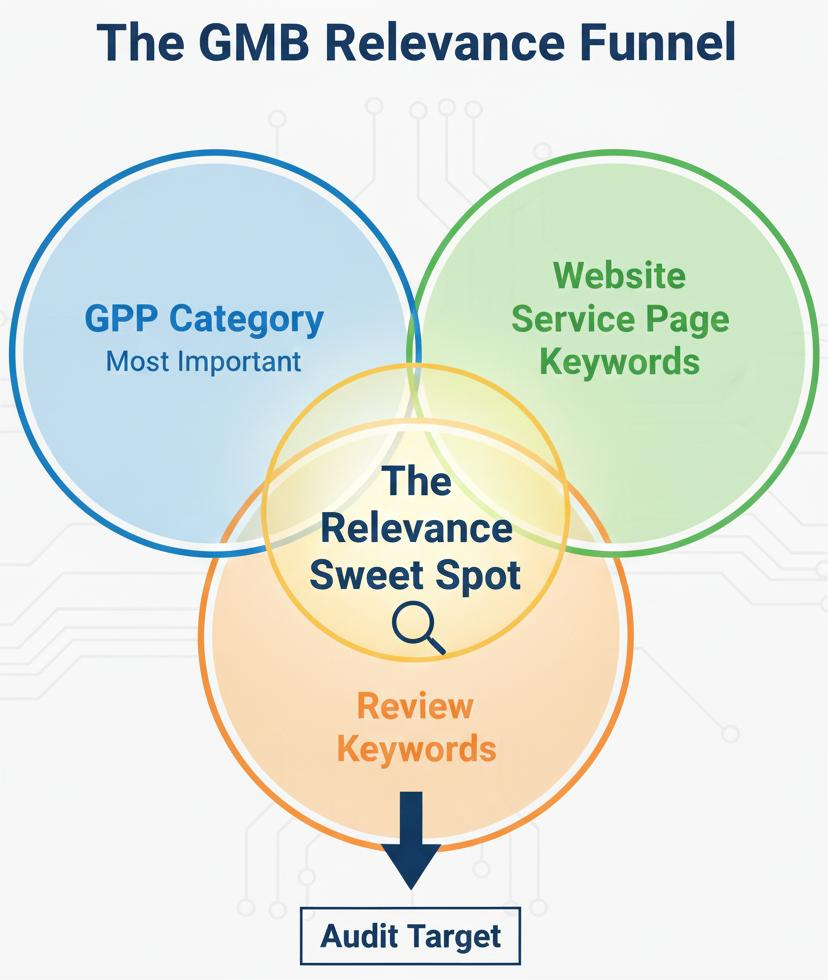
- Relevance: Does the business listing perfectly match what the customer is searching for? This is about keyword placement and category selection.
- Prominence: How well-known is the business online? This relies on external factors like citations, links, and the quantity/quality of reviews.
- Proximity (The Uncontrollable Factor): How close is the business to the person searching? However, you can optimize the first two pillars so strongly that you overcome slight proximity disadvantages.
Pillar 1: The Technical GMB Profile Audit (The On-Listing Fixes)
The Google Business Profile (GBP, formerly GMB) is your most important tool. First, you must ensure the core data is 100% accurate. Then, you will use advanced optimization techniques to signal relevance to Google.
NAP Consistency (Name, Address, Phone)
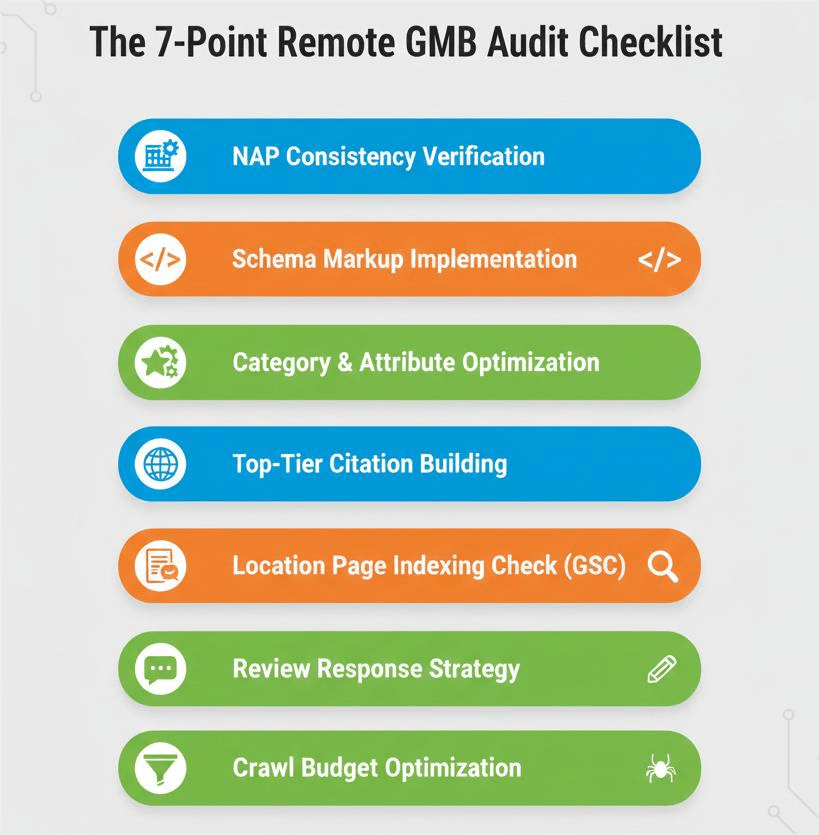
This is the foundation. A client’s Name, Address, and Phone number must be identical everywhere online. For example, if the business uses “St.” on their website, they must use “St.” (not “Street”) on their GBP.
Therefore, you should check these four places:
- The GBP Profile: The official listing.
- The Website Contact Page: The page Google trusts most.
- Local Schema Markup: The hidden code (see Pillar 2).
- Top-Tier Citations: Yelp, Yellow Pages, industry directories.
Category Deep Dive (The High-Impact Fix)
The primary business category is the most powerful ranking signal. However, most clients stop at one. Consequently, you must audit all secondary categories.
- Audit Check: Review the client’s top 3 local competitors. Next, identify every category they use. Then, apply all relevant categories (up to 9) to the client’s GBP. For instance, a “Barber Shop” might also be an “Hair Salon” and a “Men’s Grooming Service.”
GBP Attributes and Service Area
Crucially, use the Attributes section (e.g., “Free Wi-Fi,” “Wheelchair Accessible”). This is low-hanging fruit for ranking in long-tail searches. In addition, for service-area businesses (like Cleaning Services that travel), ensure the physical address is hidden and the correct service areas (e.g., “West London,” “Kensington”) are accurately listed.
Product/Service Listings and Posts
Many local businesses ignore the Products or Services tabs. However, these are critical for boosting relevance. Therefore, you must fill these sections with keyword-rich descriptions. Finally, establish a cadence for creating new GBP Posts (offers, events, news) to show Google the profile is active.
Pillar 2: Website Integration and Schema Audit
The website serves as the technical anchor for the Google Business Profile. Google needs to see consistent, verifiable data between the GBP and the site’s code. This is where your technical expertise shines.
Local Schema Markup Implementation
Local Schema is hidden code on the website that clearly tells Google the business’s details. Specifically, you must implement the LocalBusiness or Organization schema type on the homepage or contact page.
Therefore, the audit must confirm the schema contains the following items:
- Type: (e.g., LocalBusiness, BarberShop).
- Exact NAP: The identical Name, Address, and Phone number used everywhere else.
- Geo-Coordinates: (Latitude and Longitude) to eliminate any location ambiguity.
- URL to GBP: A link to the client’s Google Business Profile.
Moreover, for service businesses, you should also implement Service schema on individual service pages (e.g., “Deep Cleaning Service”).
On-Page Optimization for Local Pages
The primary local ranking signal comes from the keywords used on the website. Consequently, you must audit the client’s city or service area pages (e.g., the “Washington” landing page for the barber).
You must check:
- Title Tag & H1: Must contain the city and the service (e.g., “Best Barber Shop in Washington D.C.”).
- Body Content: Must organically mention local landmarks, neighborhoods, and geo-specific terms. In other words, the content must be unique and authentic to the location.
- Image Alt Text: All images on the local page should include geo-modifiers (e.g., <img alt=”barber cutting hair in Washington D.C.”>).
Fixing Indexing and Speed Issues
Remember our previous work on technical health? Similarly, local pages must be indexed and fast to rank.
- Indexing Check: Use the GSC URL Inspection Tool to ensure the local landing page is not blocked by a noindex tag and is indexed correctly (referencing the expertise from Post #1).
- LCP/Speed Check: The page must load fast (LCP under 2.5s). Thus, if the page is slow, you must apply the technical fixes from our speed blueprint (Post #2) to the local landing page. Furthermore, slow local pages will severely limit their ranking potential.
Pillar 3: Local Authority Signals (The Trust Builder)
Google assesses a local business’s Prominence by looking at external signals across the web. However, for consultants working remotely, you must know which signals truly matter for local ranking, especially without physical presence.
Building High-Quality Citations Remotely
Citations are mentions of a business’s NAP (Name, Address, Phone) on other websites. Crucially, these do not need to be from “local” IP addresses. You can build these remotely.
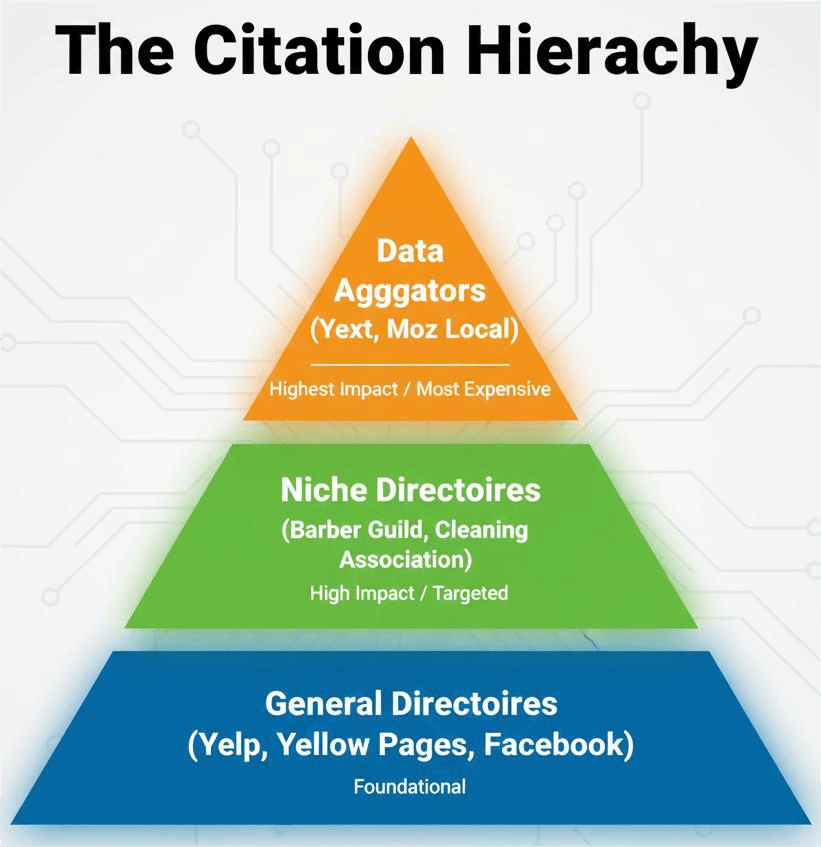
- Top-Tier Directories: Focus on major, authoritative directories specific to the client’s target country. For instance, for a US client, consider Yelp, Yellow Pages, BBB. For a UK client, Yell.com is vital. Also, seek out niche-specific directories (e.g., “Barber Directory Washington”).
- NAP Consistency is King: Every single citation must have the identical NAP to what’s on the GBP and website. Otherwise, inconsistencies confuse Google and dilute authority. Therefore, a core part of your audit is manually checking top citations for accuracy.
- Data Aggregators: Some services distribute NAP data to hundreds of smaller directories. However, for high-value audits, focus on direct manual submissions to the top 20-30 most impactful ones.
Review Management Strategy (Beyond “Get More Reviews”)
Reviews are a massive ranking factor for prominence. However, it’s not just about quantity.
- Audit for Review Quality: Are reviews keyword-rich? Do they mention specific services or cities? For example, “Great haircut by John at the Washington D.C. barber shop!” is far more impactful than “Good service.”
- Response Strategy: Google rewards businesses that respond to reviews, both positive and negative. Therefore, your audit must include a review response strategy.
- Review Velocity: Consistent, fresh reviews are better than a single burst. Consequently, a good audit includes a plan for ongoing, ethical review generation.
Pillar 4: Crawl Budget & Indexing Optimization
Even with perfect NAP and a great GBP, your local pages won’t rank if Google can’t find and understand them efficiently. This pillar is often overlooked, giving you a significant competitive edge.
Optimizing for Googlebot’s Efficiency
Google has a limited “crawl budget” for every website. Thus, you need to ensure it’s not wasted.
- Eliminate Crawl Waste: Identify and block low-value pages (e.g., old promotional pages, irrelevant filters) using robots.txt or noindex tags. This ensures Googlebot focuses its energy on your important local landing pages.
- XML Sitemap for Local Pages: While a single sitemap is common, consider submitting a separate XML sitemap for your local landing pages to GSC. This highlights their importance and ensures Google knows exactly where they are.
Frequently Asked Questions (The PAA Integration)
When searching for a Remote GMB Audit, your clients often have specific, practical questions that need clear, authoritative answers. By answering these common People Also Ask (PAA) questions, we further establish your expertise and claim more search real estate.
PAA 1: Is a GMB Profile required for a service area business (SAB)?
Short Answer: No, a physical location is not required.
Detail: The profile is still necessary. You must select the option to hide your address. Then, you will input the specific service areas you target (e.g., “Washington D.C. Metropolitan Area”). Consequently, this ensures your listing appears only when a customer searches within those zones.
PAA 2: What is the risk of using virtual office addresses for Local SEO?
Short Answer: The risk is severe.
Detail: Using a virtual office or a P.O. box is against Google’s guidelines. Therefore, your profile is highly susceptible to suspension. Instead, if the client operates only as an SAB, audit the profile to ensure the physical address is hidden. This is safer and fully compliant.
PAA 3: Should I use the exact same content on my multi-city location pages?
Short Answer: Absolutely not.
Detail: Using duplicate content confuses Google’s indexing algorithms. Specifically, this creates a high risk of one page being “filtered” out of the search results. Instead, your audit must ensure each location page has unique content. For example, include specific local testimonials, staff names, or neighborhood references to prove the page’s uniqueness.
PAA 4: How often should a GMB Profile be audited for compliance?
Short Answer: At least quarterly.
Detail: Local SEO is not a one-time fix. Competitors are constantly changing categories, and Google releases new features monthly. Therefore, a quarterly technical audit is the minimum requirement. Finally, this ensures NAP remains consistent and avoids listing suspensions.
Final Thoughts: Delivering the #1 Rank on Google Maps
The goal of ranking #1 on Google Maps is achieved not by luck, but by technical command over the four pillars. You have learned that your location does not matter. Your Remote GMB Audit system, based on this technical blueprint, allows you to deliver best-in-class results to global clients (Barbers in Washington, services in London).
You now possess the authoritative system for fixing technical issues (indexing, speed) and mastering the local listing’s code (Schema, NAP, Citation quality). Consequently, you can transform a stagnant local business into a lead-generation machine.
Your authority is now established.
The Final Step to Domination
Managing a global portfolio of audits, technical fixes, and ongoing content creation requires significant time and oversight.
- Indexing Prerequisite: Remember, local pages must be indexed to rank. If you are struggling with GSC indexing issues, check our guide on [Shopify Products are Not Ranking].
- Speed Prerequisite: Map rankings are performance-based. Ensure your local page loads instantly using the insights from our [Core Web Vitals Consulting Services].
- Authority Reinforcement: For further reading on Google’s quality standards, consult the [Official Google Quality Rater Guidelines].
- Don’t let technical GMB confusion limit your revenue. If you need this entire Remote GMB Audit system implemented and managed by a technical consultant, contact us for a personalized audit and strategy session today.
See how this fits into the broader [SEO Evolution 2026 Blueprint here]. For a deeper look into the future, check out my full guide on [Generative Engine Optimization 2026].
To truly dominate, you need to understand how to build Entity Authority for your brand.
Comments are closed.