
Search has changed forever. Initially, we optimized our websites for a list of blue links. However, today we are in the era of the “Answer Engine.” This shift is known as Generative Engine Optimization (GEO). Consequently, if your content is not “AI-friendly,” your brand will become invisible to your customers in Generative Engine Optimization 2026.
Furthermore, the goal is no longer just to rank #1. Instead, the goal is to become the primary source that AI models like ChatGPT and Google Overviews cite. As a result, traditional keyword stuffing is dead. To win in 2026, you must provide clear, authoritative, and unique value that an AI can easily summarize.
From 10 Blue Links to Generative Answers:
A History. Initially, the search was simple. We used keywords, and Google gave us a list of websites. However, the introduction of “RankBrain” and “BERT” changed everything. Consequently, Google began to understand intent rather than just words.
Furthermore, as we enter 2026, the launch of advanced AI agents has created a “Zero-Click” environment. As a result, users no longer need to click a website to get an answer. Therefore, your strategy must shift. You shouldn’t just want a click; you want to be the “Knowledge Source.” By understanding this history, we can see that GEO isn’t just a trend—it is the final destination of search technology.
The Evolution of Search: From Keywords to Conversations
To understand where we are going in 2026, we must first look at how we arrived here. Initially, search engines were simple indexing machines. In the early 2000s, SEO was a game of “keyword density.” If you repeated a word enough times, you ranked. However, this led to a poor user experience filled with spam. Consequently, Google began a decades-long journey to prioritize quality over quantity.
The first major shift occurred with the “Panda” and “Penguin” updates. Suddenly, the focus moved from mere repetition to “Authority” and “Backlinks.” Furthermore, with the release of the “Hummingbird” algorithm, Google stopped focusing on individual keywords and began examining “Entities” and “Concepts.” As a result, search became more about the relationship between ideas than the words themselves.
By the time we reached the 2020s, AI had already begun to play a silent role behind the scenes. Technologies like BERT and MUM allowed search engines to understand the nuance of human language. Initially, this only changed the search results page. However, the launch of Generative AI in late 2022 triggered a total revolution. Consequently, we entered the era of “Zero-Click Search.”
In 2026, the landscape is entirely different. Users no longer want to browse a list of ten websites to find an answer. Instead, they want a direct, synthesized response from an AI assistant. Therefore, the old tactics of “Meta Tag optimization” alone are no longer enough to survive. Because search is now conversational, your brand must be “conversational” too.
Ultimately, this evolution has led us to Generative Engine Optimization (GEO). We have moved from “Matching Keywords” to “Providing Answers.” Furthermore, we have shifted from “Earning Clicks” to “Building Trust.” As a result, if your content does not satisfy the AI’s need for high-quality data, you will be left behind in the archives of the old internet. However, by mastering the five pillars of Generative Engine Optimization 2026, you can position yourself at the very top of this new digital frontier.
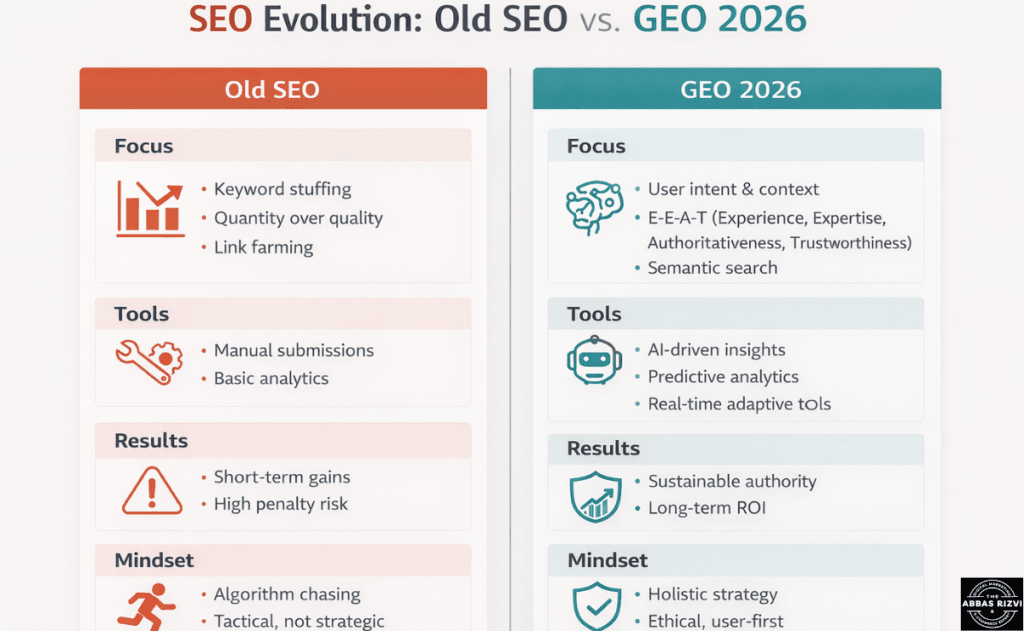
Pillar 1: Authoritative Data in Generative Engine Optimization 2026
The first pillar of GEO is all about trust. Because AI models are trained to avoid “hallucinations,” they prioritize content that links to high-authority data. Therefore, every claim you make on your blog should be backed by a credible source.
In addition to external trust, you need “Information Gain.” This is a new SEO concept for 2026. It means your content must add something new to the conversation. If you simply repeat what is already on Wikipedia, the AI will ignore you. However, if you share a unique case study or a personal “The Abbas Rizvi” framework, the AI sees you as a primary source.
Ultimately, you want the AI to say, “According to Abbas Rizvi…” rather than just giving a generic answer. This is how you build digital authority in the modern age.
Why “Average Content” is a Risk in 2026 Because
AI models are trained on the existing web; they already know what everyone else is saying. If you write a blog post that says “SEO is important,” you are providing zero “Information Gain.” Consequently, search engines will categorize your content as “Duplicate Value.”
Instead, you must provide “The Abbas Rizvi Perspective.” For example, share a specific experiment where you changed one technical element on a site and saw a 20% boost in AI citations. Generative Engine Optimization 2026, By doing this, you create “New Data.” Ultimately, Google’s 2026 Helpful Content Update prioritizes this “Newness” above everything else.
Pillar 2: Quote Accuracy & Direct Answer Blocks
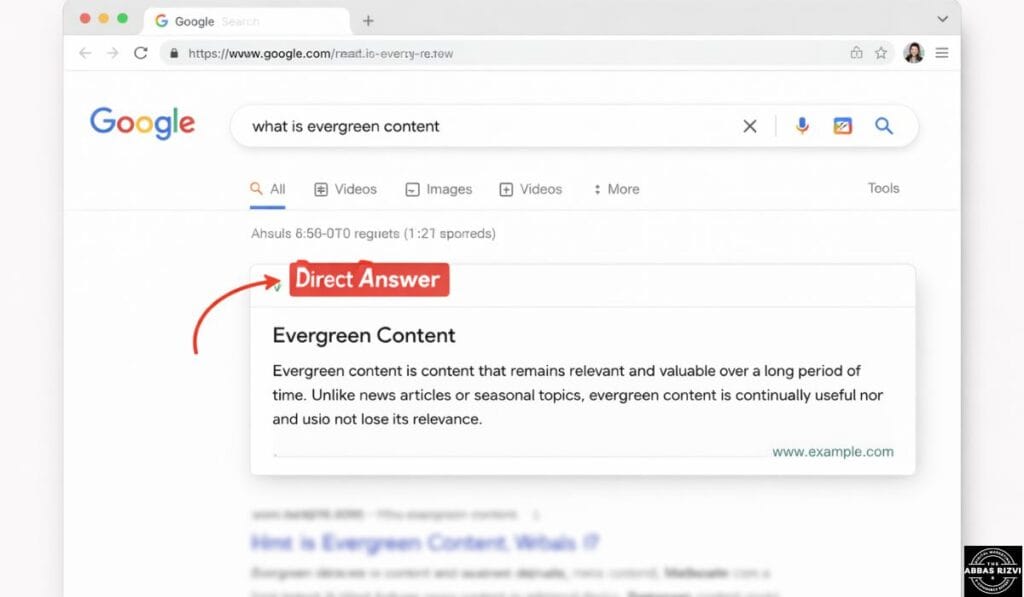
AI models love “quotable” content. Initially, SEOs wrote long, winding introductions to keep people on the page. However, in 2026, the AI needs to find the answer in seconds. Therefore, you should use “Direct Answer Blocks” at the start of every section.
Specifically, you must use clear and declarative sentences. For example, instead of saying “It might be considered that SEO is changing,” you should say “SEO is now an answer-based discipline.” Consequently, when an AI bot scrapes your site, it finds a perfect snippet to show the user. Furthermore, by being direct, you improve your Flesch Reading Ease score, which makes your content more accessible to everyone.
Pillar 3: Data-Driven Insights & Statistics
Why does AI prioritize one site over another? Because numbers don’t lie. AI engines are programmed to look for hard data, percentages, and statistics. As a result, a blog post filled with data is seen as more “expert” than a post filled with opinions.
In addition to using global stats, you should include your own unique data. For instance, share the percentage increase in traffic you saw after a technical audit. By doing this, you provide the “Evidence” that Google’s E-E-A-T guidelines require. Ultimately, Generative Engine Optimization 2026, including a simple table or a bulleted list of statistics, makes your page a “data goldmine” for search engines.
Schema Markup and the LLM (Large Language Model)
Map In addition to visible text, your “Backend” must be perfect. Initially, Schema was just for star ratings. However, in 2026, we will use “Speakable Schema” and “Dataset Schema.”
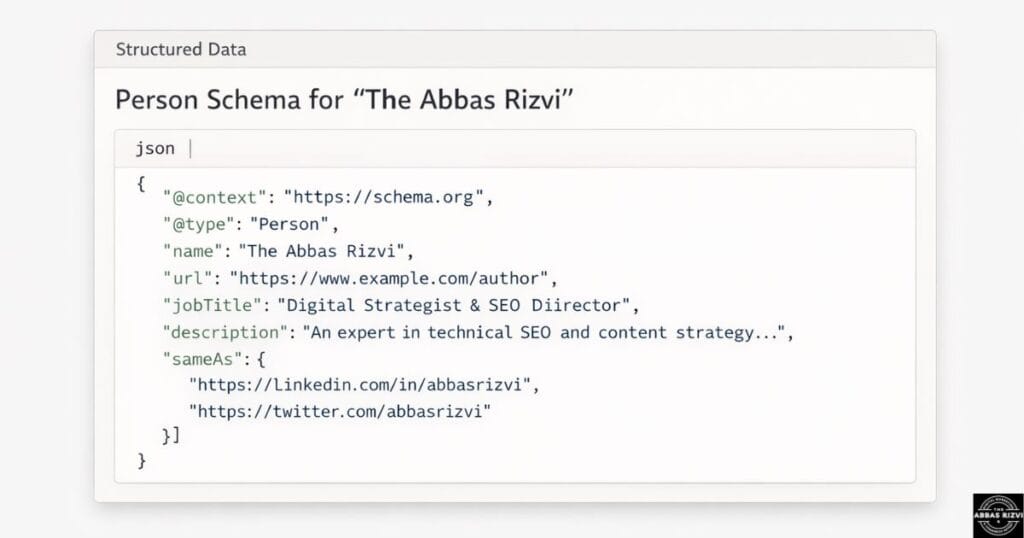
Specifically, you need to tell the AI exactly who you are. By using JSON-LD code, you can link your About Page, your LinkedIn, and your professional certifications together. Therefore, when an AI “crawls” your site, it sees a connected web of authority. As a result, you aren’t just a blogger; you are a verified “Entity” in the Google Knowledge Graph.
Technical GEO: The Schema Architecture of 2026
While the words on your page are vital, the “hidden code” in your backend is what truly powers Generative Engine Optimization. Initially, SEOs used Schema Markup simply to get “Rich Snippets,” such as star ratings or price tags. However, in 2026, Schema has evolved into the primary language that Large Language Models (LLMs) use to verify your identity. Consequently, if your technical architecture is weak, the AI will not trust your content enough to cite it as a source.
Specifically, we must look at JSON-LD (JavaScript Object Notation for Linked Data). This is the bridge between your website and the Google Knowledge Graph. Because AI models seek to connect “Entities,” you must use Schema to define exactly who you are. For example, using Person and Organization Schema allows you to link your “About Page” directly to your social profiles and professional credentials. As a result, you are no longer just a string of text; you become a verified “Authority Entity.”
Furthermore, 2026 has introduced the necessity of “Speakable” Schema and “FactCheck” Markup. Initially, these were niche tools. However, as voice search and AI assistants dominate the market, these tags tell the AI which parts of your article are the most important to read aloud. Therefore, by tagging your “Direct Answer Blocks,” you are essentially “highlighting” your best content for the AI’s attention. Ultimately, this reduces the chance of the AI “hallucinating” or misquoting your brand.
In addition to identity markup, we must focus on the “Dataset” Schema. If you are following Pillar 3 and providing unique statistics, you must wrap that data in Dataset tags. By doing this, you make your data “discoverable” for AI researchers and search engines. Consequently, your unique insights can be pulled into AI-generated charts and summaries. This is the highest form of “Information Gain.” Instead of just talking about data, you are delivering it in a machine-readable format.
Finally, we cannot ignore Technical Performance as a GEO signal. Because AI crawlers are now more active than ever, they prioritize sites that load instantly. Therefore, your Core Web Vitals must be in the “Green” zone. As a result, a fast, Schema-heavy site acts as a “Fast Lane” for AI indexing. Ultimately, Technical GEO is not about tricking the system; it is about making your high-quality information as easy as possible for a machine to digest, trust, and distribute Generative Engine Optimization 2026.
Pillar 4: Simple Formatting & Structural Hierarchy
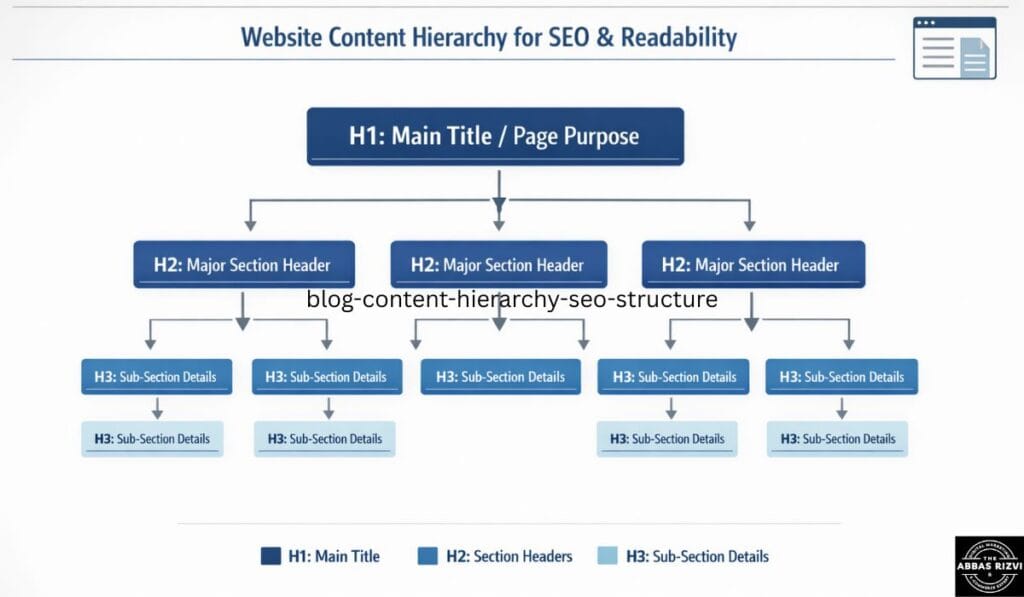
Search engines and AI models both crave organization. Initially, many creators focused only on the “look” of a page. However, in 2026, the structure is what dictates your ranking. Therefore, you must use a clear hierarchy of H2 and H3 tags.
Furthermore, you should break up heavy walls of text with bullet points and numbered lists. Because AI “scans” your site just like a human does, simple formatting allows the engine to categorize your information quickly. Consequently, well-structured content is more likely to be featured in the “Quick Answers” section of search results. In addition, this layout makes your “Flesch Reading Ease” score skyrocket, keeping your readers engaged for longer.
Pillar 5: Unique Human Insights (The “Abbas” Factor)
The final pillar is the most important one for Generative Engine Optimization 2026. Because AI can now generate basic content, Google is looking for “Human-First” signals. As a result, you must include personal stories, unique frameworks, or “The Abbas Rizvi” perspective in every post.
Specifically, don’t just explain a concept; explain how you used it to solve a real-world problem. By doing this, you prove your Experience (E-E-A-T). Ultimately, an AI can summarize data, but it cannot share a human experience. Therefore, your unique voice is your greatest SEO weapon. If you lead with personality, you will build a brand that no algorithm can replace.
Your Monthly GEO Audit: A Step-by-Step Guide
To stay at the top, you must audit your content every 30 days. First, check your “AI Citation Rate.” Second, look for “Content Decay.” Third, update your external links to ensure they still point to the most recent 2026 data.
Furthermore, you should test your own site using tools like ChatGPT or Perplexity. Ask the AI: “Who is the best SEO expert for GMB audits?” If your name doesn’t come up, you need to increase your “Brand Signals.” Consequently, this proactive approach ensures you are never surprised by a core algorithm update.
The Future-Proof GEO Audit: Your 2026 Checklist
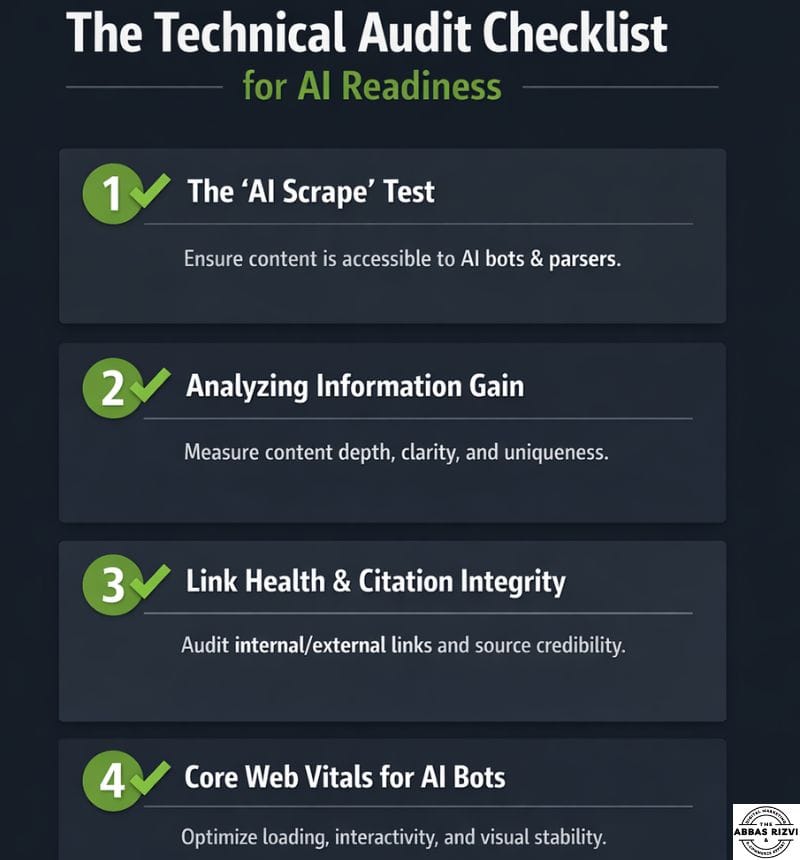
Once you have implemented the five pillars of Generative Engine Optimization, your work is not finished. Initially, SEO was a “set it and forget it” task. However, in 2026, the AI models that power search results are updated almost daily. Consequently, you must perform a regular audit to ensure your content remains a “Primary Source.” By following this checklist, you can maintain your authority even as the algorithms evolve.
1. The “AI Scrape” Test
First, you should manually test how AI perceives your page. Open a tool like ChatGPT-5 or Google Gemini and ask it a specific question that your article answers. If the AI provides your name or website as a citation, your GEO is working. However, if it gives a generic answer without credit, you need to improve your “Direct Answer Blocks.” Therefore, this real-world test is the most accurate way to measure your success.
2. Analyzing Information Gain
Furthermore, you must ask: “Does this page still offer new value?” Because competitors are constantly publishing new content, your “unique” insights might become common knowledge over time. As a result, you should update your blog every 90 days with fresh statistics, new case studies, or updated “Abbas Rizvi” frameworks. Ultimately, search engines prioritize the most recent “Human-Verified” data.
3. Link Health & Citation Integrity
In addition to content updates, you must audit your external links. Initially, you may have linked to a study that was relevant last year. But in the fast-paced world of Generative Engine Optimization 2026, that data might be outdated. Consequently, you must replace old links with the latest industry reports. By doing this, you signal to Google that your page is a high-quality, living, and breathing resource.
4. Core Web Vitals for AI Bots
Finally, don’t ignore the technical speed. Because AI crawlers process massive amounts of data, they prioritize sites that respond instantly. Therefore, use your Google Search Console to ensure your “Largest Contentful Paint” (LCP) is under 1.2 seconds. Specifically, a fast site is no longer just for users; it is now a requirement for AI accessibility.
Frequently Asked Questions (FAQ)
Q1. What is the main difference between SEO and GEO?
A.Traditional SEO focuses on ranking in a list of web links. Conversely, GEO focuses on making your content the preferred answer for AI generators like ChatGPT and Google Gemini. Therefore, while SEO is about “where” you rank, GEO is about “how” you are summarized.
Q2. Why is “Information Gain” important in 2026? Because
A. AI models already have access to all the basic information on the web; they look for new data. Consequently, if you provide a unique case study or a fresh perspective, you are more likely to be cited as an authority.
Q3. Does word count still matter for ranking?
A.The focus has shifted from quantity to quality. Initially, long-form content was the gold standard. However, in Generative Engine Optimization 2026, being concise and direct is more effective for AI-driven search results.
Q4. How can I improve my E-E-A-T for GEO?
A. Generative Engine Optimization 2026: You should focus on the “Experience” factor. Specifically, you can do this by sharing personal results, behind-the-scenes photos, and client success stories. As a result, search engines will recognize you as a real human expert.
Q5. Is GEO only for big brands?
A.Not at all. In fact, smaller brands often have more unique, “niche” information to share. By using specific GEO tactics, a local consultant can outrank a global corporation in specialized AI answers.
Final Thoughts: Mastering Generative Engine Optimization 2026
The digital landscape is evolving at a breakneck pace. Initially, businesses could rely solely on traditional search tactics. However, as we have explored in this guide, Generative Engine Optimization 2026 is now the primary factor for digital visibility. By focusing on the five pillars we discussed, you are doing more than just updating a website; you are future-proofing your entire brand.
Furthermore, the shift toward Generative Engine Optimization 2026 represents a move toward higher-quality, more transparent, and more human-centric content. Because AI models prioritize trust and “Information Gain,” your unique expertise is your most valuable asset. Consequently, those who adapt to Generative Engine Optimization 2026 early will lead the conversations in their respective industries.
Ultimately, search engines are looking for innovators. Therefore, as you implement these strategies, remember that Generative Engine Optimization 2026 is about building a lasting connection with your audience through AI-driven clarity. As a result, you won’t just rank higher—you will become the most trusted authority in your niche.
Let’s Dominate 2026 Together!
Are you ready to take the lead? Whether you are just starting your journey or looking to refine your current strategy, Generative Engine Optimization 2026 is the key to your success.
[Click Here to Schedule a Strategy Session with Abbas Rizvi]
By partnering with an expert, you can ensure that your brand stays at the cutting edge of Generative Engine Optimization 2026. Let’s make this year your most dominant one yet!
“Ready to optimize your own site? Follow my deep-dive on [Technical SEO for GEO] to learn how to prune scripts and modernize your media for the AI era.”
Comments are closed.