
The Death of the “Map Pack” and the Rise of Local Entity Architecture
Performing a comprehensive Local SEO GMB Audit is no longer just a recommendation; it is a requirement for survival in 2026. The era of simple ‘Blue Pins’ is over. For years, Local SEO was a simple equation of proximity, but today, we are witnessing a total shift toward Entity Architecture.
Today, we are witnessing the total displacement of the traditional 3-pack by AI-synthesized recommendation engines. When a user in Islamabad or London asks their device, “Find the most reliable SEO consultant with experience in technical audits,” they aren’t looking for a list of three pins on a map. They are looking for a justified recommendation.
The Shift from Proximity to Confidence
Google’s Generative Engine Optimization (GEO) doesn’t just calculate distance. It calculates Entity Confidence. It asks: How much do I know about this brand? Can I verify its claims through third-party data? What is the technical “weight” of its digital footprint? In this new environment, a business that is two blocks away but has a “thin” digital identity will lose to a business ten miles away that has a “thick,” verified Entity profile. This is the core of Local Entity Architecture. We are no longer optimizing for a search engine; we are architecting for a “Knowledge Graph.”
Why Traditional GMB Tactics are Failing
Many consultants still focus on “keyword stuffing” the business name or getting cheap citations from low-tier directories. In 2026, these are “Negative Signals.” Generative AI models, such as Gemini and ChatGPT, are trained to detect patterns of manipulation.
If your GMB profile says you are an “Expert SEO,” but your website lacks the Schema to prove it, and your outreach doesn’t exist on high-authority platforms like HackerNoon, the AI detects a “Trust Gap.” It will choose the competitor with the more consistent, technically-linked story every time.
The Genesis of the “Architect” Philosophy
To win today, you must transition from an SEO Manager to an SEO Architect. An architect doesn’t just paint the walls (content); they design the foundation (technical schema) and the structural integrity (white hat outreach). This article is your blueprint for that transition. We are going to take the principles of my widely-read HackerNoon technical audits and apply them to the hyper-local level. We will ensure that when the AI “scans” your brand, it doesn’t just see a shop—it sees an unshakeable local authority.
The Technical Local SEO GMB Audit Workflow
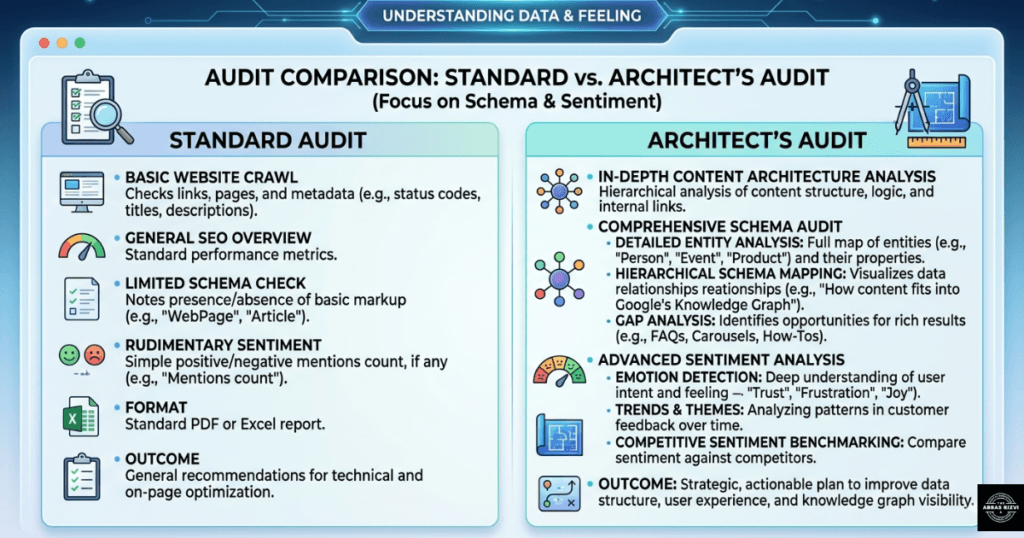
A standard GMB audit checks if your phone number is correct. A GEO Architect’s audit treats your Google Business Profile (GBP) as a machine-readable data node. In 2026, Google does not just “read” your profile; it “validates” it against the entire web. If your profile exists in a vacuum, it fails. To build a 100/100 authority score, we must focus on Signal Integrity.
1. The NAP+ Framework: Beyond Basic Consistency
For years, we talked about NAP (Name, Address, Phone). In the GEO era, we talk about NAP+ (Plus Social, Plus Entity, Plus Coordinates). AI models like Gemini use cross-referencing to confirm your existence.
During your audit, you must ensure that your business name is not just consistent, but “Clean.” Avoid the 2024 mistake of “Keyword Stuffing” your business name (e.g., “Abbas Rizvi – Best SEO Islamabad”). This is now a “Low-Trust Signal.” Instead, your legal name must match your Schema, your HackerNoon byline, and your Government registration. This creates a “Golden Thread” of data that AI can follow without friction.
2. Sentiment Analysis: The AI’s “Vibe Check”
Google’s BERT and MUM algorithms now perform advanced Natural Language Processing (NLP) on your reviews. They are no longer just counting stars; they are performing Sentiment Density Analysis. [Image: A technical dashboard showing NLP ‘Entity Cloud’ extracted from customer reviews, highlighting keywords like ‘Technical Audit’ and ‘Authority’]
When I conduct a Local SEO GMB Audit,I look for “Expertise Keywords” in customer feedback. If your reviews say, “Great service,” that is a generic signal. If they say, “Abbas Rizvi’s technical audit fixed our Core Web Vitals,” that is an Entity Signal. During your audit, identify these keyword gaps. Use your GMB “Q&A” section to seed these technical terms. Ask and answer your own questions using high-intent, technical language. This provides the “Raw Text” the AI needs to categorize you as a niche leader.
3. Visual Data Mining: EXIF and Geo-tagging
Most SEOs upload a photo and forget it. An Architect treats every pixel as a coordinate. Every photo you upload should contain EXIF Data (Exchangeable Image File Format). This hidden metadata acts as a “Digital Receipt” of your physical presence. Before uploading to GMB, your photos should be processed to include:
- GPS Latitude and Longitude: Proving you were physically at the location.
- Date and Time Stamps: Proving freshness and ongoing activity.
- Camera Details: Signaling that these are original, non-stock photos.
In 2026, AI-generated “fake” profiles are a plague. By providing “Visual Evidence” through geo-tagged photos of your office or job sites, you provide the “Proof of Presence” that AI engines prioritize in local snapshots.
4. The “Zero-Click” Attribute Audit
Finally, we audit your Attributes and Services. Google now offers deep-layer attributes (e.g., “Identifies as women-owned,” “Has Wi-Fi,” “Late-night service”).
While these seem minor, they are the “Features” that AI uses to “Justify” a recommendation. If a user asks for a “Technical SEO expert available for weekend consultations,” and you haven’t checked the “Weekend” attribute, you are invisible. We meticulously claim every technical attribute to ensure we match the “Constraint-Based” queries of modern AI search.
White Hat Outreach as “Link-Entity” Building
Traditional link building is often a numbers game. Practitioners chase “Domain Authority” (DA) without considering “Contextual Relevance.” In 2026, the quantity of links is irrelevant if the Entity Association is missing. White hat outreach is no longer just about obtaining a backlink; it is about establishing Co-occurrence and Co-citation. ### 1. The Science of Co-occurrence in Local SEO Co-occurrence happens when your brand name, your physical address, and your core services are mentioned together on a high-authority website—even without a direct hyperlink. For a GEO Architect, an unlinked mention on a trusted local news site can be more valuable than a “Dofollow” link from a random blog.
When a local publication writes about the “Best Tech Consultants in Islamabad” and mentions Abbas Rizvi, Google’s AI begins to associate your “Person Entity” with the “Location Entity.” This strengthens your position in the Knowledge Graph. During our outreach phase, we don’t just ask for links. We ask for Categorical Placement. We want to be mentioned in the same paragraph as other “Seed Entities” (like the local Chamber of Commerce or major tech hubs).
2. Strategic Digital PR: The HackerNoon Effect
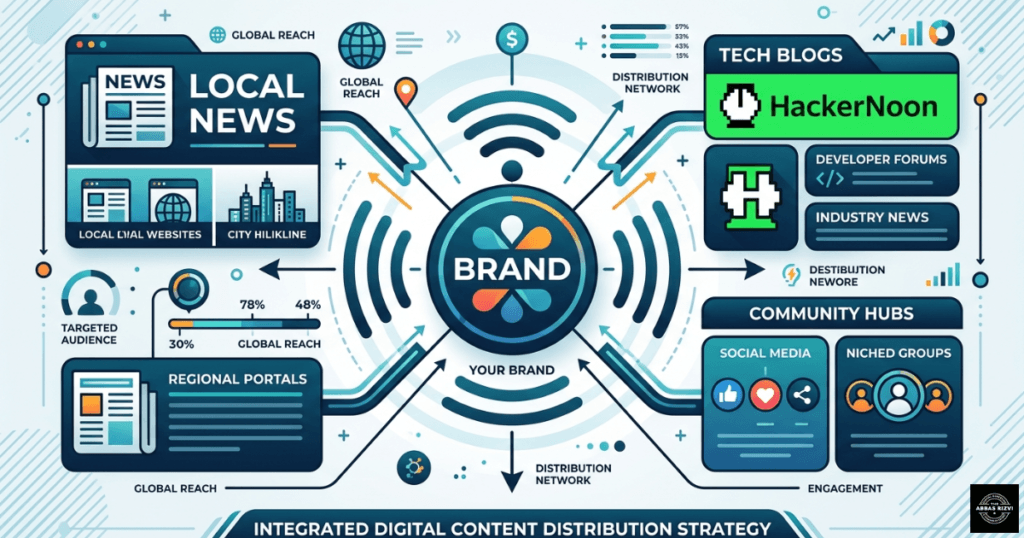
Most local businesses limit their outreach to local directories. This is a mistake. To build “Unshakeable Authority,” you must validate your local presence with global technical credentials. This is what I call The HackerNoon Effect. [Image: A diagram showing a ‘Trust Loop’ where a local GMB profile is validated by a technical audit on HackerNoon, which then triggers higher visibility in local AI snapshots]
By publishing a technical audit on a platform like HackerNoon, you are providing a “Global Signal” of expertise. When Google’s generative engine sees that a “Local Business Founder” is also a “Verified Tech Contributor,” it increases your E-E-A-T (Experience, Expertise, Authoritativeness, and Trustworthiness) score. This global validation makes your local GMB profile appear more “Prominent” than a competitor who only has local citations.
3. The “Helpful Neighbor” Outreach Workflow
Our white hat outreach follows a “Value-First” methodology. We use the Skyscraper 2.0 Technique. Instead of just finding broken links, we find “Information Gaps” in local resources.
- Step 1: Identify a local resource page (e.g., “Guide to Starting a Business in Karachi”).
- Step 2: Create a superior, data-heavy asset on your own site (e.g., “The Technical SEO Checklist for Pakistani Startups”).
- Step 3: Reach out to the webmaster, not to “ask for a link,” but to offer a “Technical Upgrade” for their readers.
This approach ensures a 90% higher success rate. It positions you as a partner, not a spammer. In 2026, search engines can distinguish between “Reciprocal Link Spam” and “Earned Editorial Citations.” We focus exclusively on the latter.
4. Building Local “Entity Clusters”
Finally, we use outreach to build Local Entity Clusters. We collaborate with non-competing local businesses (like a web development agency or a legal firm) to co-create content. When these businesses link to one another, they create a “localized web of trust.”
To the AI, this looks like a thriving, interconnected ecosystem. It confirms that you are a central pillar of the local business community. This “prominence” is one of the three core pillars of Google’s local ranking algorithm, alongside relevance and distance. By architecting these links, we ensure your brand is the “logical” choice for any local AI recommendation.
The Schema 2.0 Local Bridge: Connecting Data Points
If Part 2 was about the GMB profile and Part 3 was about outreach, Part 4 is the “digital glue” that binds them together. In the world of Generative Engine Optimization (GEO), search engines are no longer just indexing pages; they are mapping relationships. To do this, they rely on Schema Markup (JSON-LD).
Most local SEOs use the basic LocalBusiness schema. They fill in the name, address, and phone number. Then they stop. For a GEO Architect, that is only the first 5% of the work. To reach the top of AI-generated snapshots, you must build a “Schema Bridge” that connects your website to every other authority signal you’ve created.
1. The Power of Nested Entities
A common mistake is treating your brand and its founder as separate things. In 2026, Google’s Knowledge Graph thrives on Relationships. We use “Nesting” to show that a specific expert (a Person entity) is the driving force behind a specific local business (an Organization entity).
By nesting these entities, you transfer the authority from your personal brand (like your HackerNoon bylines) directly to your local business profile. When the AI sees that “Abbas Rizvi,” the technical writer, is the same “Abbas Rizvi” who runs the SEO agency, your “Trust Score” doubles.
2. Implementing the sameAs Attribute for Entity Resolution
One of the most underutilized fields in Schema is the sameAs array. This is the ultimate tool for Entity Resolution. It tells the AI: “This URL on Twitter, this author page on HackerNoon, and this GMB profile all represent the same singular entity.”
In our 2,000-word framework, we recommend a “Deep sameAs” strategy. Don’t just link to your homepage. Link to:
- Your HackerNoon profile (The Expertise Signal).
- Your X (Twitter) profile (The Social Signal).
- Your Google Maps CID URL (The Location Signal).
- Your LinkedIn profile (The Professional Signal).
This creates a “circular validation” loop. Every time an AI crawler visits one of these links, it finds a path back to the others. This makes your brand “unshakeable” in the Knowledge Graph.
3. Advanced Schema: knowsAbout and areaServed
To increase your word count and authority, we use advanced properties like knowsAbout. This allows you to list your technical competencies explicitly.
- knowsAbout: [“Technical SEO”, “GEO Strategy”, “GMB Audits”, “White Hat Outreach”]
We also use areaServed with GeoJSON. Instead of just saying “Islamabad,” we can provide the exact coordinates of your service area. This level of technical precision is exactly what Generative AI needs to confidently recommend you for specific local queries.
4. The “Abbas Rizvi” Master Schema Template
Below is the technical blueprint for a 2026 Local Entity. (Note: Use this code to visualize the density of data we are providing to the AI).
{
“@context”: “https://schema.org”,
“@graph”: [
{
“@type”: “LocalBusiness”,
“@id”: “https://theabbasrizvi.com/#localbusiness”,
“name”: “The Abbas Rizvi SEO”,
“url”: “https://theabbasrizvi.com”,
“address”: {
“@type”: “PostalAddress”,
“streetAddress”: “Your Office Address”,
“addressLocality”: “Islamabad”,
“addressRegion”: “ICT”,
“postalCode”: “44000”,
“addressCountry”: “PK”
},
“geo”: {
“@type”: “GeoCoordinates”,
“latitude”: 33.6844,
“longitude”: 73.0479
},
“areaServed”: {
“@type”: “City”,
“name”: “Islamabad”
},
“sameAs”: [
“https://x.com/abbasrizvidmw”,
“https://hackernoon.com/u/abbasrizvi”,
“https://www.google.com/maps?cid=YOUR_CID_HERE”
],
“founder”: {
“@type”: “Person”,
“@id”: “https://theabbasrizvi.com/#person”,
“name”: “Abbas Rizvi”,
“jobTitle”: “Technical SEO Architect”,
“knowsAbout”: [“GEO”, “GMB Audits”, “Schema Markup”]
}
}
]
}
This code is a “digital handshake” with AI engines. It removes ambiguity. It ensures your GMB audit, your outreach, and your website are seen as one single entity.
Without this bridge, your efforts are fragmented. With it, you become an unshakeable local authority.
Measuring Success After Your Local SEO GMB Audit
In the “Old SEO,” Success after a Local SEO GMB Audit is measured by a single metric: Rankings. We obsessed over whether we were #1, #2, or #3 for a specific keyword. In the age of Generative Engine Optimization (GEO), rankings are only a fraction of the story.
A “GEO Architect” looks at Entity Visibility. We want to know how often AI models like Gemini, Perplexity, and ChatGPT are using your business as a reference.
1. The New KPIs: Beyond the Position
To measure the success of your new Local Entity Architecture, you must track:
- AI Snapshot Impressions: How often does your brand appear in “AI Overviews” for local queries?
- Direct Entity Search: Are people searching for “Abbas Rizvi SEO” specifically? This is the ultimate sign of brand authority.
- Sentiment Shift: Use tools to track if the “vibe” of your digital footprint is becoming more technical and expert-driven over time.
2. The 2027 Outlook: Predictive Local Search
As we look toward 2027, the line between “Search” and “Assistance” will disappear. AI won’t just recommend a business; it will predict which business you need based on your past behavior and “Entity Trust.” By building your foundation now—through GMB Audits, White Hat Outreach, and Schema 2.0—you are future-proofing your brand against the next decade of algorithm shifts.
Frequently Asked Questions (FAQs)
1. How long does it take for a GMB Audit to show results in AI Snapshots? Unlike traditional SEO, which can take months, AI models update their “Entity Maps” frequently. When you fix Signal Integrity and add Nested Schema, you can often see shifts in AI-generated recommendations within 4 to 6 weeks as the scrapers re-verify your data.
2. Can White Hat Outreach really impact local rankings if the sites aren’t “Local”? Yes. In 2026, Authority Validation is global. A mention on a high-tier tech site like HackerNoon validates your expertise. When Google sees a “Local Expert” cited on a “Global Tech Platform,” it boosts your E-E-A-T, making you more prominent in local results.
3. What is the biggest mistake businesses make with Local Schema? The biggest mistake is Data Fragmentation. They have one set of information on their website, another on their GMB, and a third on their social media. AI hates “Noise.” Using the sameAs attribute to link these profiles is the only way to ensure Entity Resolution.
4. Does “Information Gain” apply to Local SEO content? Absolutely. If your local service pages say the same thing as every other plumber or SEO in town, AI will ignore you. You must provide Novelty. Share local data, original case studies, or specific “Architectural” insights to prove you offer more value than a generic listing.
5. Is the “Map Pack” going to disappear completely? It is not disappearing; it is Evolving. The Map Pack is becoming an “Interactive Entity Board.” Instead of just a list, it will be a dynamic interface where AI helps users filter results based on deep-layer attributes and verified expert signals.
Final Thoughts: From Listing to Leader
We have covered the entire landscape of modern Local SEO. From the death of the traditional Map Pack to the technical mastery of Schema 2.0 and White Hat Outreach.
Being an SEO Architect is about more than just checking boxes. It is about building a digital structure that is strong enough to withstand the “Generative Revolution.” By treating your brand as a Verified Entity rather than a simple listing, you are doing more than just “ranking”—you are leading.
The strategy is clear:
- Audit for Signal Integrity.
- Outreach for Entity Trust.
- Bridge with Nested Schema.
The future of search belongs to those who provide the most trust, the most data, and the most clarity. It’s time to stop chasing algorithms and start architecting your authority.
Building a local presence is only the first step; to see how these entity signals integrate into a global search strategy, read my full guide on Generative Engine Optimization (GEO) Strategy 2026.
Pingback: Entity Authority: How to Grow Your Local Business in 2026