
The High-Stakes World of Emergency Search
First, let’s define the environment. In the restoration industry, you are not selling a luxury; you are providing a critical emergency service. Whether it is a burst pipe in a New York high-rise or mold growth in a London flat, the user is in a state of panic. Consequently, they lack the patience to browse through pages of search results. Dominating Restoration Company SEO is the only way to capture urgent leads in 2026.
They need an answer immediately. Furthermore, Google’s AI Overviews (AEO) are now designed to provide that immediate answer. If your restoration business—or your client’s business—is not the primary entity recommended by the AI, you are losing the most profitable leads in the market. This blueprint outlines how to dominate the Local Map Pack and AI prompts for the US and Global restoration markets.
In the hyper-competitive world of disaster recovery, mastering Restoration Company SEO is the difference between a ringing phone and a silent office.
Strategy #1: Restoration Company SEO: Strategy for Zero-Second Local Domination
Optimizing the Google Business Profile (GBP) for Emergency Intent
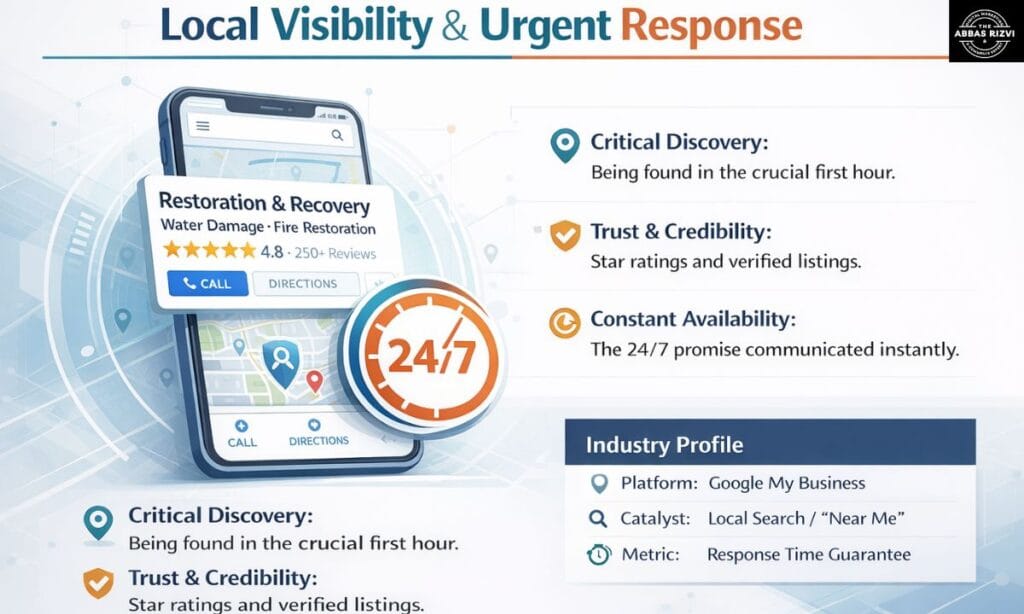
In the US market, the Google Map Pack accounts for over 40% of all clicks for “water damage” queries. Therefore, Google Maps isn’t just a map; it’s a cornerstone of any local Restoration Company SEO campaign. Your GBP is your most important digital asset.
- NAP Consistency (Global Standard): Your Name, Address, and Phone number must be identical across every directory. Additionally, use a local area code to indicate geographic proximity, even when targeting a broader region.
- Secondary Categories: Do not just list “Water Damage Restoration.” Instead, include “Fire Damage Restoration,” “Mold Remediation,” and “Building Inspector” to capture the full breadth of emergency entities.
- Review Velocity: Google’s AI tracks how often you receive reviews. Consequently, a company that gets 5 reviews a week is seen as more “Active” and “Trustworthy” than one with 100 old reviews.
- External Link: Link to Google’s Official Guide to Getting Reviews
The “Active Signal” & Review Justifications
To achieve true “Zero-Second” dominance, we must exploit Google’s Real-Time Attributes. For the US and Global markets, this means activating the “Emergency Service” and “24/7” tags within your GBP dashboard. Consequently, when a user in a crisis searches for “emergency water extraction,” the AI prioritizes profiles that explicitly signal readiness. Furthermore, utilize GBP Posts as a disaster newsroom. By posting a “Local Storm Update” or a “Safety Tip” once a week, you signal to the algorithm that your business is operationally active and ready to deploy crews. Without the right 24/7 signals, your Restoration Company SEO efforts will fail to convert late-night leads.
Another critical layer is Local Justifications. Google often pulls text directly from reviews to “justify” why it is showing a business (e.g., “Their website mentions water extraction”). To capture this, instruct your field technicians to ask clients to use specific phrases like “fast water damage response” or “professional mold removal in [City Name]” in their feedback. Ultimately, this creates a semantic feedback loop where user-generated content validates your geographic authority to the AI.
Proximity vs. Authority in AEO
Next, we must understand how AI chooses a winner. While traditional SEO relies on backlinks, AEO relies on Entity Proximity.
- Action: Create “City Pages” for every major US or Global territory you serve. However, do not use “Thin Content.” Each page must include local landmarks, local weather patterns affecting disaster rates, and local building codes.
- Geographic Deep-Linking: For global scaling, ensure your City Pages don’t just list a service area; they must map “Micro-Neighborhoods” and local infrastructure risks—such as historic flood zones or aging municipal pipe networks. By doing so, you prove to Google that you aren’t just a service provider, but a definitive local resource with deep contextual knowledge of the region’s specific disaster vulnerabilities.
Transition: Ultimately, this hyper-local data tells the AI that you are the most relevant expert for that specific disaster zone.
Strategy #2: Semantic Mapping for High-Ticket Restoration
Targeting “Commercial Large Loss” Entities
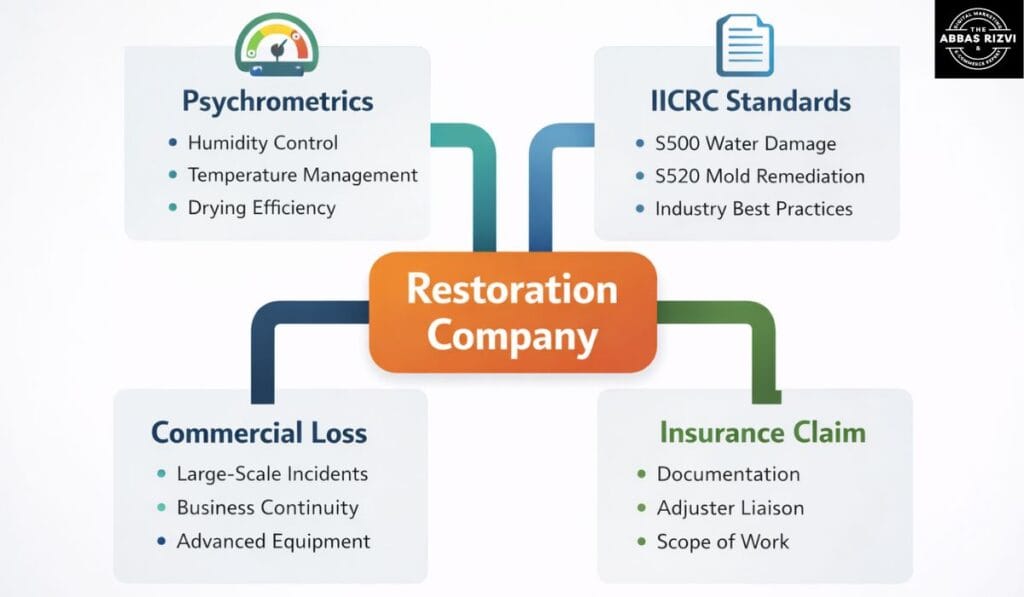
Residential leads are the “bread and butter,” but Commercial Large Loss is where the real revenue stays. To target the global commercial market, you must use technical language that property managers and insurance adjusters use.
| Technical Entity | Why It Matters for AEO |
| Psychrometrics | Proves you understand the science of drying. AI models look for this “Expertise” (E) signal. Technical language like ‘Psychrometrics’ acts as an entity signal that boosts your Restoration Company SEO profile. |
| Thermal Imaging | Signals a high-tech approach. Therefore, it attracts higher-paying commercial clients. |
| IICRC S500 Standards | The global gold standard for water damage. Mentioning this builds “Trustworthiness” (T). |
| * External Link: Official IICRC S500 Standard Overview |
The B2B Authority: Capturing the Commercial “Gatekeepers”
To dominate the high-ticket sector, your content must satisfy the Commercial Gatekeeper—the property manager or facility director. Next, you must pivot from “cleaning” language to “mitigation and recovery” language. Consequently, when a commercial entity searches for “Business Interruption Mitigation,” your site must appear as the technical answer.
Expand your content to include entities like LGR Dehumidification (Low Grain Refrigerant) and HEPA Air Scrubbing. These are not just keywords; they are “Technical Proof Points.” In summary, providing data on moisture mapping and structural integrity tells the AI that you are capable of handling industrial-scale disasters. Furthermore, by discussing “Business Continuity Planning,” you move from being a vendor to a strategic partner. This depth is exactly what Google’s AI Overviews prioritize when selecting a “Source of Truth” for complex, high-stakes queries.
Restoration Company SEO and Semantic Mapping for Commercial Leads
Semantic SEO is about creating a web of related concepts. Ultimately, Google doesn’t want to find a page about “water damage”; it wants to find an Authoritative Entity. To achieve this, your article must connect the “Restoration” entity to the “Insurance Industry” entity.
Next, incorporate phrases such as “Xactimate Estimating” and “TPA (Third Party Administrator) Compliance.” These terms are the DNA of the restoration industry. By doing so, you prove to the AI that your content is integrated into the actual professional ecosystem. Consequently, the search engine begins to rank you not just for specific words, but for the entire “Topic” of professional restoration. This semantic layering is the secret to moving your site from 74 impressions to global visibility.
Writing for “Panic Prompts”
Voice search is a rising frontier where Restoration Company SEO must focus on natural language. When a disaster strikes, users use voice search. They ask: “Siri, my basement is flooding, what do I do first?”
- The Strategy: Create a section titled “5 Immediate Steps After Water Damage.” Write these as short, numbered lists. Next, ensure each step is under 20 words.
- The Result: This structure is “Prime Real Estate” for AI snippets. In summary, the AI will read your steps aloud to the user, establishing you as the authority before they even visit your site.
Strategy #3: Technical Performance for Global Scaling
Solving the Mobile Speed Barrier
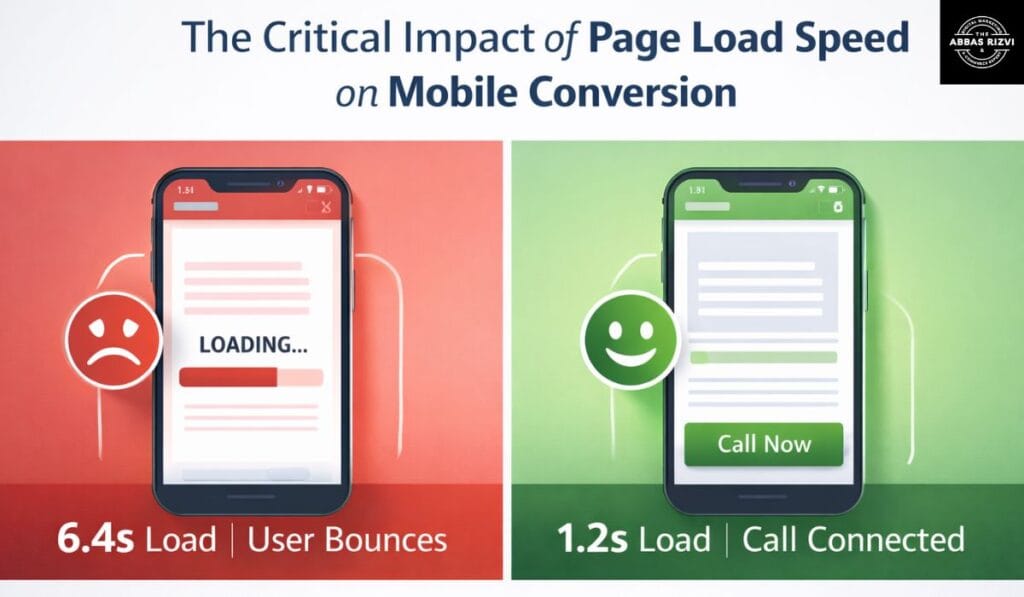
A fast site is no longer a luxury; it’s a core technical requirement for Restoration Company SEO in 2026. Your audit revealed a Largest Contentful Paint (LCP) of 6.4 seconds. In an emergency where decisions are made in moments, a six-second wait feels like six minutes. The user’s instinct isn’t patience; it’s to hit the back button and click your competitor’s link. This immediate bounce directly signals to Google’s AI that your site provides a poor user experience, harming your visibility for critical local searches. Therefore, fixing speed is not just about performance; it’s about capturing the lead before the panic sets in.
DOM Size Reduction & Asset Prioritization
To slash that 6.4s LCP, we must address the “Document Object Model” (DOM) depth. Next, audit your WordPress theme to remove unnecessary nested containers that delay rendering. Furthermore, implement Resource Hints like rel=”preconnect” for your third-party fonts and tracking scripts.
By telling the browser to start connecting to these assets before it even reaches the link in the code, you shave off hundreds of milliseconds of “latency.” In addition, prioritize the “Call Now” button by using Image Preloading for your hero background. This ensures that the most critical conversion element—the one the user needs in a disaster—is the very first thing the browser paints. Ultimately, a streamlined code structure makes your site more “crawlable” for AI bots, ensuring they don’t time out before indexing your high-value restoration content.
- Critical CSS Inlining: Identify and extract only the CSS required to render the top portion of your page—specifically the “Call Now” button, header, and emergency contact information. Inline this minimal code directly into your HTML <head>. Consequently, the browser can paint these crucial elements immediately without waiting for external stylesheets to load.
- CDN Implementation for a Global Audience: When your business serves clients across different regions, a Content Delivery Network (CDN) is non-negotiable. Services like Cloudflare or Quic.Cloud store cached versions of your site on servers worldwide. This means a homeowner in Texas and an insurance adjuster in London both experience sub-2-second load times.
- External Link: Cloudflare’s CDN explanation
Advanced Schema for Restoration Authority
For restoration companies, basic markup isn’t enough. You must implement a schema that screams credibility and immediacy to search engines.
- EmergencyService Property: Move beyond the generic LocalBusiness schema. Implement the specific EmergencyService type from Schema.org. This explicitly tells Google your business provides critical, time-sensitive services available 24/7—a powerful signal for AI Overviews answering urgent queries.
- areaServed Property: Precisely define your service area. List specific counties, cities, or postal codes. This granularity helps Google’s AI accurately match your business to relevant local searches and prevents the “Unknown URL” crawl errors seen in your Search Console.
- Internal Link: Learn more about our SEO Consulting Services
Strategy #4: Competitive Advantage: The “Insurance Adjuster” Loop
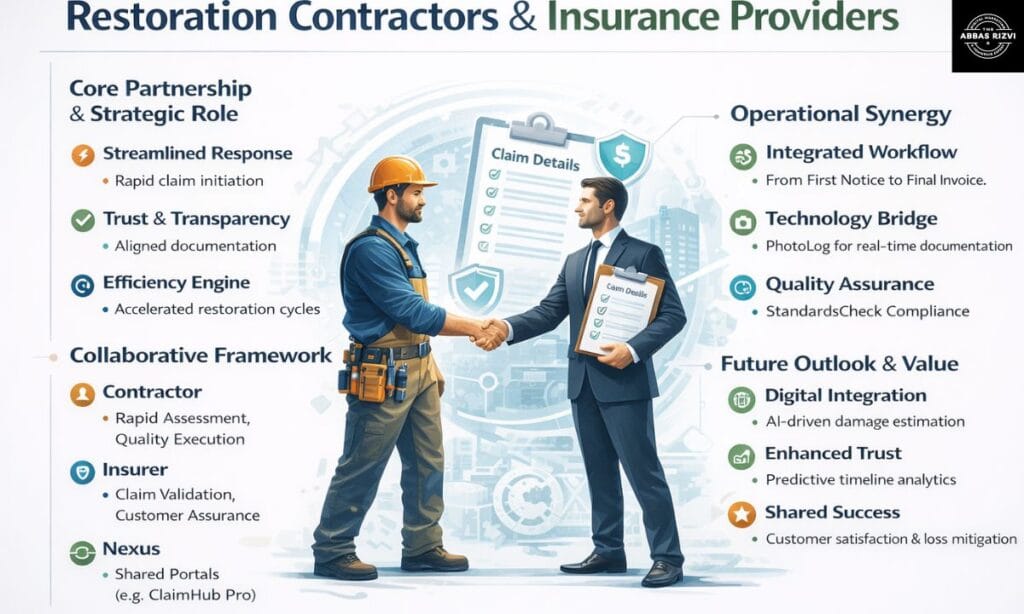
The Insurance Adjuster Loop: A B2B Restoration Company SEO Advantage
Restoration is unique because the “payer” is often an insurance company, not the homeowner. Therefore, your content must speak to two audiences simultaneously to be effective.
- The Homeowner: Needs empathy, immediate physical presence, and speed.
- The Adjuster: Needs digital documentation, technical compliance, and liability mitigation.
Bridging the “Documentation Gap”
The primary friction point in any restoration claim is the lack of standardized documentation. Consequently, when a restoration company provides transparent, real-time data, they become the “Preferred Vendor” for the insurance carrier. To exploit this, your SEO content must highlight your mastery of Xactimate and Symbility.
Furthermore, by discussing the importance of “Photo Documentation” and “Atmospheric Readings” in your articles, you are signaling to the AI that you follow the industry’s administrative best practices. In addition, this technical transparency reduces the “Claim Cycle Time.” Ultimately, the insurance adjuster isn’t just looking for a cleaner; they are looking for a contractor who makes their job easier by minimizing litigation risks and ensuring every line item is justified through IICRC-standard data.
The “Resource Hub” as a Backlink Magnet
The Fix: Create a dedicated “Insurance Professionals Portal” on your site. This isn’t just a marketing page; it is a high-value Resource Hub. Moreover, include downloadable “Compliance Checklists” and “Standard Operating Procedures (SOPs)” for various disaster scenarios like Category 3 water loss. By hosting a resource hub, your Restoration Company SEO strategy attracts elite B2B backlinks.
This strategy creates a massive “Impression Gap” between you and your competitors. By doing so, you attract high-authority backlinks from insurance agencies, law firms, and property management groups. These “Top-Tier” links tell Google’s AI that your domain is a Primary Authority in the global restoration space. Consequently, even your residential pages will rank higher because the entire site is anchored by this B2B professional trust. In summary, by solving the adjuster’s headache through your content, you secure the most profitable and recurring referral traffic in the restoration industry.
Restoration SEO FAQ
Q1: How do I beat larger restoration franchises in the US?
A: Franchises are often slow to update their technical SEO. Consequently, you can beat them by having a faster site (better CWV) and more specific, localized content that targets “Nano-Niches” like historical home restoration.
Q2: Will AI Overviews replace my local leads?
A: No. AI Overviews will direct leads. By optimizing for entities like “IICRC certified,” you ensure the AI recommends you as the trusted source.
Q3: Why is my “Water Damage” page not getting impressions?
A: It may be an “Orphan Page.” As we saw in your previous audit, if a page has “None detected” for referring pages, Google won’t show it. Ensure you link to it from your homepage.
Q4: Should I use different keywords for a Global audience?
A: The technical terms (Water Extraction, Mold Remediation) are global. However, the “Urgency Phrases” change. Use a tool like Search Console to see what local variations are appearing in your 74 impressions.
Q5: What is the best way to prove “Experience” (E-E-A-T) in restoration?
A: Use “Before and After” galleries with detailed technical captions explaining the drying equipment used. In summary, data-backed proof is the best trust signal.
Final Thoughts: Your 30-Day Restoration Authority Plan
Ultimately, dominating the restoration niche requires a blend of local precision and global authority. If you follow the technical and semantic steps outlined in this blueprint, you move from digital invisibility to becoming a primary lead source for high-ticket disaster recovery.
The 30-Day Roadmap:
- Weeks 1-2: Finalize GMB optimization and technical speed fixes (targeting that sub-2s LCP).
- Week 3: Deploy the “Insurance Adjuster” Resource Hub and build internal link siloes.
- Week 4: Monitor Search Console for the “Unknown URL” fix and track your rise in AI Overviews.
“Ready to dominate your local market? [Book a Strategic SEO Audit with The Abbas Rizvi today]. Contact us today to begin your journey toward total Restoration Company SEO authority.”