
The White-Hat Outreach Blueprint Step-by-Step
If you are currently trading $100 for a single backlink from a low-traffic directory, you are not building authority—you are managing a budget leak. Most SEO professionals treat link acquisition like a numbers game, drowning high-value content in generic email templates and low-quality guest posts. This strategy is precisely why your Domain Rating (DR) is stagnant and your competitors are pulling ahead. Building a brand in 2026 requires more than just content; it requires a White-Hat Outreach Blueprint that earns trust. In this guide, I’ll show you the exact strategy I use as an SEO Consultant.
There is a fundamental difference between cheap link trading and a white-hat strategy focused on genuine authority exchange. The former is a ticking penalty clock; the latter is the single most powerful way to guarantee long-term search dominance. Building authority requires a system that is personalized, scalable, and value-driven.
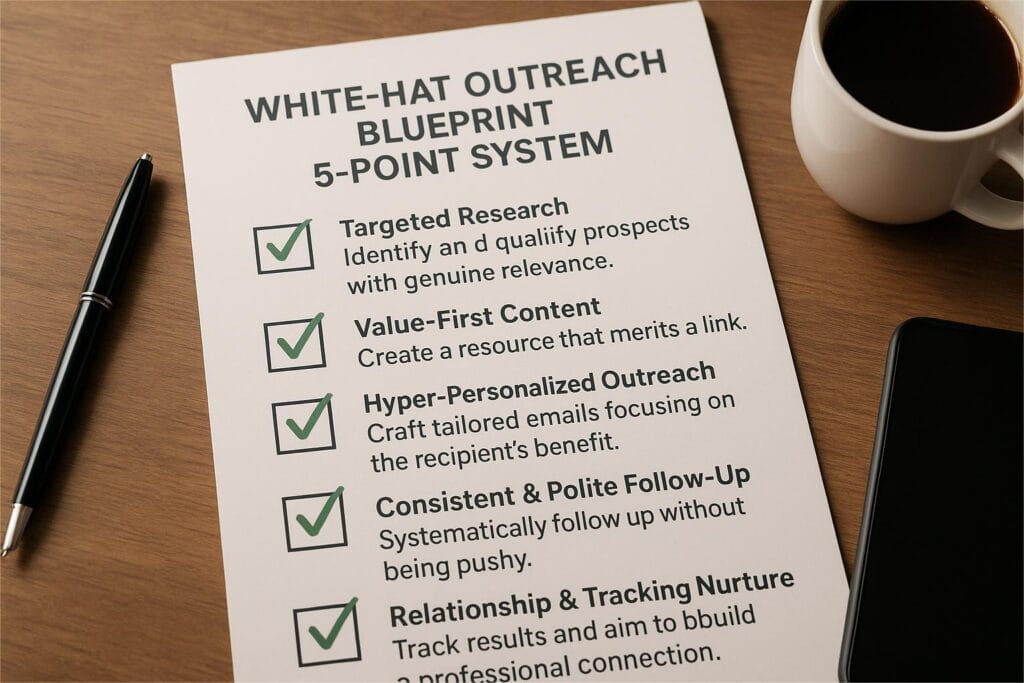
This post delivers the definitive White-Hat Outreach Blueprint. This is the exact, step-by-step system we use to secure high-DR backlinks from industry-leading publications for our consulting clients. We will break down the entire process: from vetting quality opportunities and crafting personalized outreach emails, to transforming unlinked brand mentions into high-value links. If you are ready to pivot from risky tactics to high-authority growth, this blueprint is your guide.
Scaling Authority via White-Hat Outreach
The single biggest mistake we see agencies make is prioritizing volume over quality. A single, high-authority backlink can outperform 50 low-value links, but only if that link passes a stringent vetting process. Before you write a single outreach email, you must perform a technical risk assessment on the linking domain.
Here is how the White-Hat Outreach Blueprint dictates link quality, answering the common question: How do you identify high-quality link building opportunities?
Vetting 101: DR is a Starting Point, Not the Final Decision
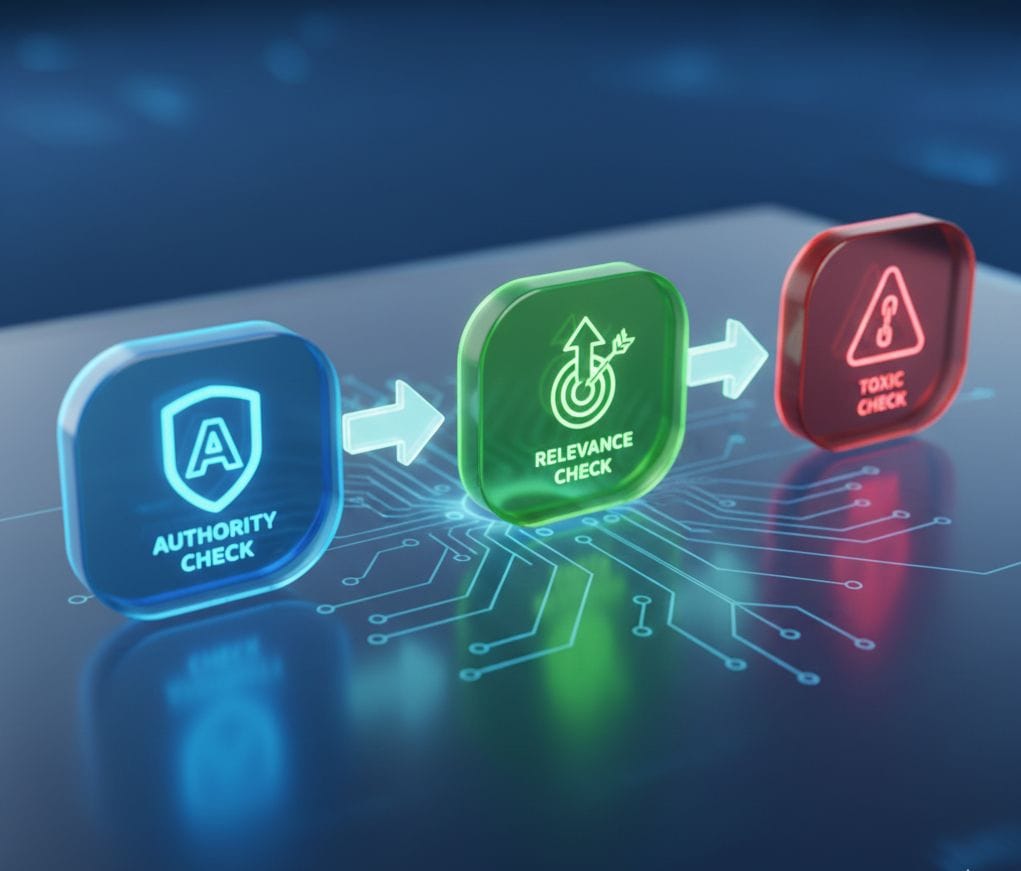
Every beginner outreach course tells you to check Domain Rating (DR), but that’s only half the story. A high DR is useless if the site is a penalty risk or irrelevant to your niche. Our vetting process is a multi-step filter designed to eliminate toxic, low-ROI sites:
- Toxic Backlink Profile Check: Does the site link to dozens of non-relevant, spammy niches (e.g., gambling, adult)? If so, Google’s trust is low, and that site is not a safe long-term partner.
- Traffic Vetting: A DR 60 site with zero organic traffic is a red flag. It means the site is either penalized or has no genuine audience. We only target sites with verifiable, stable organic traffic relevant to the US or EU markets.
- Manual Relevance Check: Does the target domain actually write about your industry? If your SaaS company is in the fintech space, a link from a general travel blog is low-relevance filler, regardless of its DR. Relevance is the ultimate quality signal.
Anchor Text Strategy: Building Links for the Right Page
Once the link target is vetted, the next strategic step in the White-Hat Outreach Blueprint is determining where the link should point and what anchor text to use. This addresses a frequent PAA question: Should I build backlinks for service pages, home pages, or blogs?
| Page Type | Anchor Text Goal | Risk Level |
| Home Page | Brand/Naked URL (e.g., “Abbas Rizvi Consulting”) | Low |
| Blog Posts | Informational/Long-Tail (e.g., “Off-Page SEO tactics in 2025”) | Low |
| Service Pages | Exact Match Keyword (e.g., “Technical SEO Consulting”) | High (Requires Caution) |
While exact-match anchor text is highly potent for ranking specific service pages, over-optimization is a major penalty trigger. The White-Hat Outreach Blueprint maintains a maximum exact-match anchor text ratio of 5% across all external links to mitigate risk and maintain a clean profile.
The Blueprint – Proven White-Hat Outreach Tactics
Once you have identified a perfectly vetted, high-quality target, the focus shifts entirely to value-driven communication. High-authority site editors delete generic, mass-produced emails instantly. This is why the White-Hat Outreach Blueprint relies on highly personalized, single-purpose emails that treat the editor’s time as the most valuable commodity.
The Best Outreach Practices: From Generic Pitch to Value Exchange
The standard PAA question is: What are the best link building outreach practices? The answer is simple: value first, request second. Our system is based on finding a genuine, specific reason to contact the editor that benefits them, not just you.
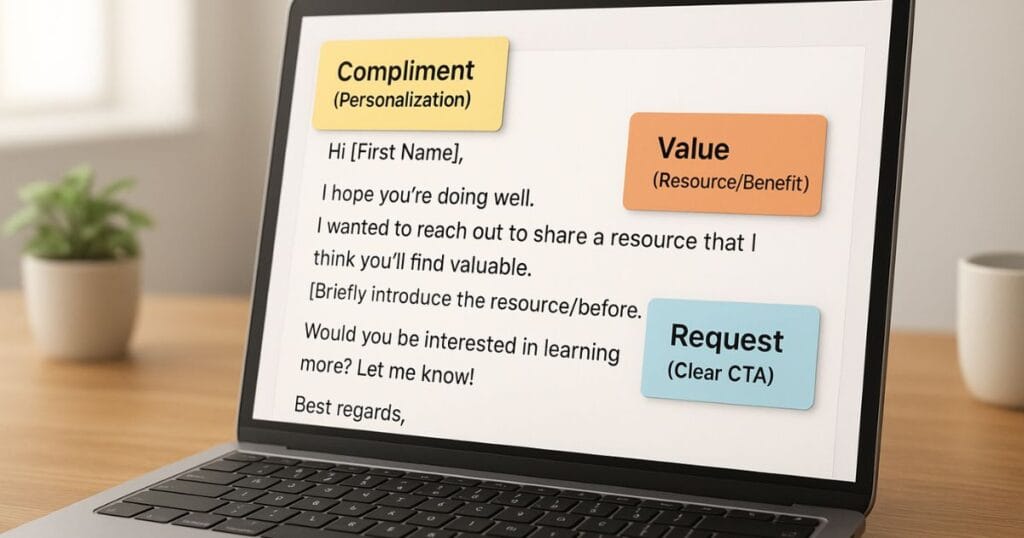
Our three-step personalized email formula:
- The Hyper-Specific Compliment: Reference a specific point or statistic in their recent article. Show you actually read it. (e.g., “I loved your analysis on Q3 Core Web Vitals data…”)
- The Value Proposition (The Fix): Point out a genuine improvement opportunity on their site. This could be a broken link to a competitor, an outdated statistic, or a superior piece of content (yours) that would benefit their readers.
- The Low-Friction Request: Ask only for the link placement you identified. Avoid asking for general guest posts or future collaborations.
This highly focused method cuts through the noise and significantly increases placement rates.
Turning Unlinked Brand Mentions into Authority Backlinks
This is one of the lowest-hanging fruits in the entire White-Hat Outreach Blueprint. Every established business has articles that mention its name or product without linking back to its site.
- The Problem: The journalist or blogger trusted your brand enough to mention it, but forgot the final step: adding the hyperlink.
- The PAA Solution: How do you turn brand mentions into quality backlinks?
- The Tactic: Use tools (like Ahrefs or specialized media monitoring services) to scan the web for unlinked mentions of your brand name. The outreach is simple and direct: “Thanks for the mention in your article on X topic! Would you mind hyperlinking our company name for easy access to our readers?”
Since the editor has already trusted your brand, the conversion rate on this tactic is often above 40%.
The Skyscraper Technique: A Modern Application
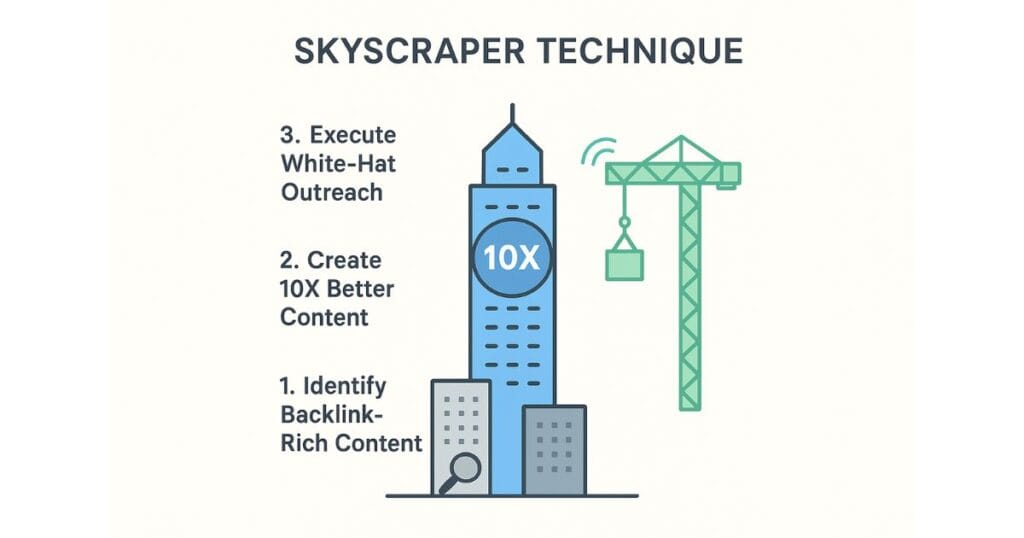
The Skyscraper Technique is powerful, but only when executed correctly. The question: What is the Skyscraper Technique and does it still work? The answer is yes, but it must be based on genuine “outcontenting.”
- Identify Link-Rich Content: Find a top-ranking article in your niche that has 50+ backlinks.
- Create 10X Better Content: Produce an article that is significantly deeper, more current, and better designed than the competitor’s—this is your “skyscraper.”
- Target the Linkers: Use the White-Hat Outreach Blueprint to contact every site that linked to the original, inferior content.
Your pitch is: “You linked to [Competitor’s Article] (which is outdated/missing this data). We just published a definitive guide that covers X, Y, and Z. Would you mind updating your link to the newer, more accurate resource for your readers?”
This strategy positions you as the definitive authority in the niche.
The Consultation Angle – Monitoring & Avoiding Risk
A link building campaign is never “set it and forget it.” Without continuous monitoring and risk assessment, even a robust outreach effort can be undermined by a competitor’s negative SEO attack or a change in Google’s algorithm. This section covers the essential final steps in the White-Hat Outreach Blueprint that ensure long-term domain safety.
Toxic Links and the Disavow Tool
The most frequent question we receive when discussing link building history is: Is buying backlinks bad, and what links should I disavow?
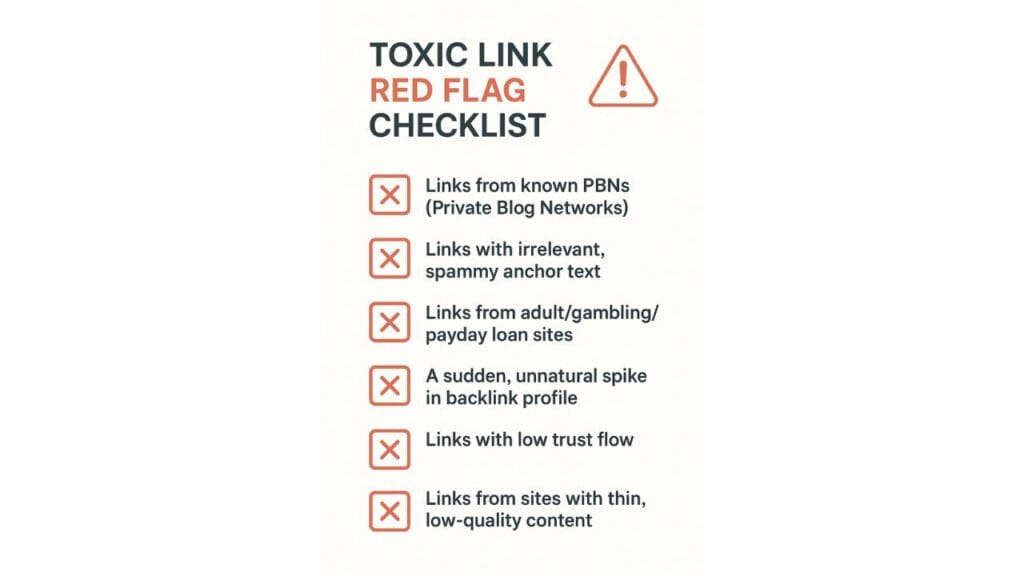
The Answer: Yes, buying links purely for SEO purposes is against Google’s Webmaster Guidelines and is considered a high-risk tactic. Any link acquired from a spam network, PBN (Private Blog Network), or a site that clearly has no topical relevance to your brand is a liability.
The White-Hat Outreach Blueprint includes a mandatory Toxic Link Audit every quarter. We look for sites that meet three criteria:
- Low/Zero Organic Traffic: The domain has no real visitors.
- Unnatural Anchor Text: The site uses the same exact-match keyword anchor text repeatedly.
- Irrelevance: The site covers unrelated, high-risk topics (e.g., gambling, pharmaceuticals).
If toxic links are found, we use the Google Disavow Tool as a last resort. This tells Google to ignore those specific links, protecting your domain’s health. Ignoring this step is the single fastest way to invite a manual penalty.
Transparent Reporting: Monitoring and Tracking
Clients hire experts for results, and the White-Hat Outreach Blueprint concludes with a reporting structure that is completely transparent. This answers the final PAA question: How should a link building campaign be monitored and tracked?
A trustworthy link building report must focus on quality, not just quantity:
- Acquisition Status: A live tracker showing which vetted targets have linked (Link Status: Live, Pending, Rejected).
- Quality Metrics: The specific Domain Rating (DR) and traffic of each acquired link.
- Anchor Text Diversity: A breakdown confirming that the new links maintain a healthy, diverse, and low-risk anchor text profile.
This focus on transparent, quality metrics builds confidence and justifies the premium rate for a high-authority consulting service.
Final Thoughts: Implementing the White-Hat Outreach Blueprint
Delivering consistent, high-DR link acquisition is not about sending more emails; it’s about executing a precise, risk-mitigated strategy. You now possess the White-Hat Outreach Blueprint, covering vetting, outreach tactics, and the necessary reporting to ensure long-term domain health.
If you are ready to stop wasting budget on low-value links and want this entire system implemented by a Technical SEO Consulting Expert to build genuine authority for your business, contact us for a personalized Off-Page Strategy Consultation today.
For a deeper look into the future, check out my full guide on [Generative Engine Optimization 2026].
Comments are closed.