
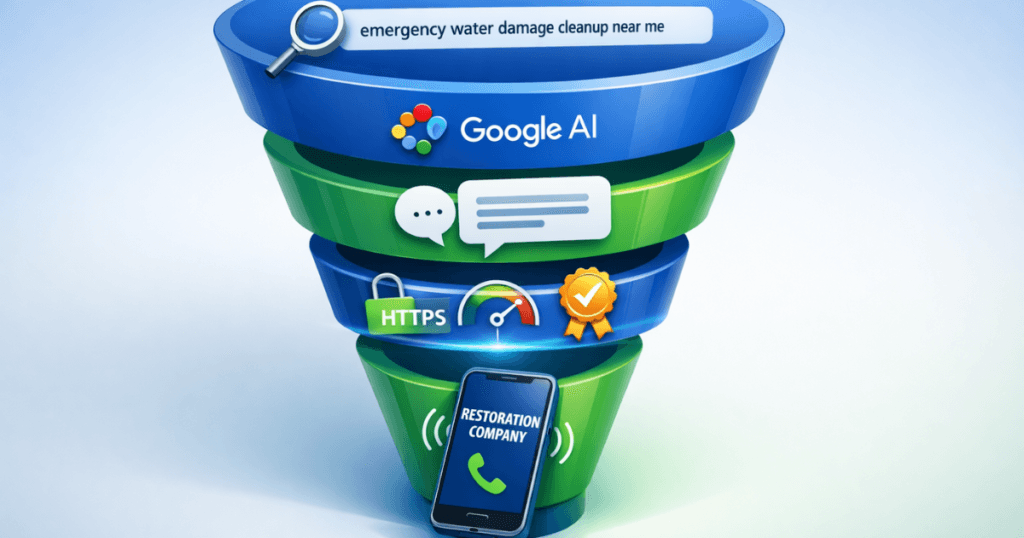
When a homeowner frantically searches “emergency water damage cleanup near me,” Google’s AI Overview now answers directly—and if your restoration company SEO isn’t optimized, those high-value disaster leads are going straight to your competitors. This shift isn’t coming; it’s here. Consequently, restoration companies that rely on traditional local SEO are watching their phones stop ringing. However, this crisis is also your greatest opportunity. By adapting your technical foundation and content strategy for AI search, you can position your company as the trusted, authoritative source that Google’s AI must cite.
Why AI Overviews Are a Disaster Recovery Emergency
The $15,000 Lost Lead: A Real Scenario
Imagine this: a pipe bursts in a premium home. The homeowner grabs their phone. Previously, they might have scrolled through the local map pack. Now, Google’s AI instantly provides a summarized answer, pulling information from what it deems the most trustworthy sources. If your site is slow, lacks clear service definitions, or shows no credentials, you are invisible. Therefore, a lead worth $15,000 or more vanishes in seconds. This scenario repeats daily for fire, mold, and storm damage searches.
How Insurance Adjusters & Agents Now Use AI Search
Your referral network is changing, too. Insurance professionals are under pressure to provide fast, reliable recommendations. Increasingly, they use conversational searches like “top-rated water mitigation company in [City] with IICRC certification.” An AI Overview that synthesizes your credentials, response time, and service details becomes a powerful validation tool. Essentially, your restoration company SEO now directly influences your largest source of referrals. To understand how AI is reshaping all search, read my guide on Technical SEO for Google’s AI Overviews.
Phase 1: The Non-Negotiable Technical Foundation
If Google’s crawlers struggle to access your site, the AI will ignore it. Your technical setup must signal reliability and speed—the two things a panicked customer needs most.
Fixing Core Web Vitals for Emergency Page Loads
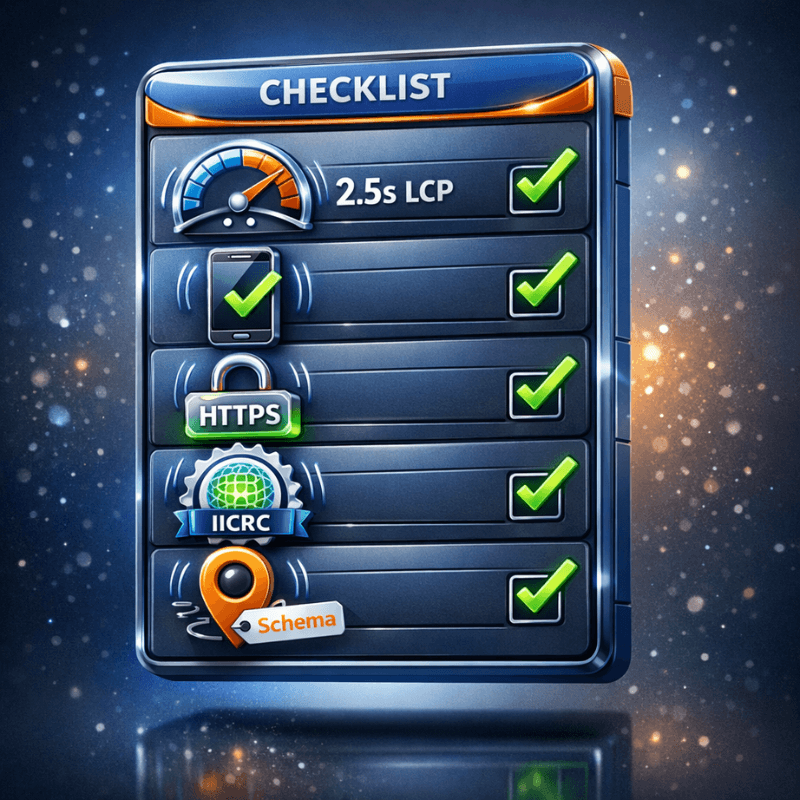
Your website’s loading speed is a direct trust signal. A slow site suggests a slow response. The key metric is Largest Contentful Paint (LCP), which should be under 2.5 seconds.
- Immediate Action: Compress all before/after gallery images to WebP format. Use a caching plugin and ensure your hosting uses a server close to your primary service area.
- Result: A fast site assures both users and AI that you are efficient and professional.
Mobile Optimization for Panicked Homeowners
Disasters don’t happen at a desktop. Nearly 100% of emergency searches are on mobile. Therefore, your site must be flawless on phones.
- Immediate Action: Test every page on a mobile device. Buttons must be large and tappable. Forms must be ultra-simple. Crucially, your phone number must be clickable at the top of every page.
- Result: A seamless mobile experience reduces bounce rate and tells Google you prioritize user needs.
Security & Trust Signals (HTTPS, Certifications)
Would you trust a restoration company with an “unsecure” website? Neither would an AI. Basic security is the foundation of trust.
- Immediate Action: Ensure your site runs on HTTPS. Next, create dedicated pages for your IICRC certifications, insurance partner logos, and manufacturer certifications. Display these prominently.
- Result: These elements are critical for the Trustworthiness in Google’s E-E-A-T framework, which AI Overviews heavily weigh.
Phase 2: AI-Optimized Content Architecture
AI doesn’t read for pleasure; it scans for facts. Your content must be structured for immediate extraction, not narrative flow.
Service Page Architecture for Water, Fire, & Mold
Each service must have a dedicated, deeply detailed page. For example, “Water Damage Restoration in [City]” should be a comprehensive hub.
- Template: Start with a clear H1: “Emergency Water Damage Restoration & Mitigation | [Your Company].” Then, immediately list your 24/7 phone number. Subsequently, use H2s for “Our Process,” “Equipment Used,” and “Insurance Claim Assistance.”
- Benefit: This clear hierarchy helps the AI understand and catalog your specific expertise.
The “Emergency Response” Content Template
People in crisis use specific language. Your content must match it. For instance, create content around:
- “What to do in the first 30 minutes after a basement flood.”
- “How to document fire damage for your insurance claim.”
- These guides solve urgent problems and are rich with keywords the AI associates with emergency response. For a deeper dive into structuring content for AI, see my AEO Blueprint.
Localized Disaster Zone Targeting
Google’s AI understands geography. After a major storm, searches spike in specific zip codes.
- Strategy: Create localized content for areas you serve. For example, “Storm Damage Roof Repair in [Neighborhood]” or “Flood Cleanup for Homes Near [Local River].”
- Outcome: This hyper-local targeting makes you the most relevant result for both users and AI in your core service areas.
Phase 3: Deploying Advanced Schema for Restoration
Schema markup is the universal language that tells search engines exactly what your content means. For restoration, it’s your direct line to the AI. Learn more at Schema.org.
Emergency Service Schema Markup
This specialized schema tells Google you provide critical, time-sensitive services.
- Implementation: Use a plugin like Rank Math or SEOPress to add the EmergencyService schema to your homepage and contact page. Include your service area radius and 24/7 availability.
- Impact: It directly increases the chance of appearing for “emergency” queries in AI Overviews.
IICRC Certification & Insurance Partner Markup
Your credentials are your competitive edge. You must make them machine-readable.
- Implementation: Use the Organization and Person schema. In the employee property, list your certified technicians. Use the sameAs property to link to your IICRC certification page.
- Impact: This feeds the Expertise, and the Authoritativeness signals that AI Overviews require a source to cite.
Before/After Gallery Structured Data
Visual proof is powerful. Use the ImageObject schema to tag your before-and-after photos with detailed captions that explain the damage and solution.
- Implementation: Describe the type of damage (e.g., “Category 3 water loss”), the process used, and the outcome.
- Impact: This provides the AI with rich, credible visual data it can reference when answering “what does water damage restoration look like?”

Phase 4: Building E-E-A-T for Disaster Response Trust
Experience, Expertise, Authoritativeness, and Trustworthiness are not just guidelines—they are the core system AI uses to judge your site.
Showcasing Certifications & Training
Don’t just list certifications; explain their meaning.
- Action: Create a “Why Our Certifications Matter” page. Explain what IICRC S500 or AMRT training entails and why it leads to better outcomes.
- Result: This demonstrates deep Experience and Expertise.
Insurance Partnership Documentation
Insurance partnerships are a huge trust signal. Feature logos of insurers you work with, and explain the direct billing process.
- Action: Publish case studies (with permission) showing how you smoothly handled a complex insurance claim from start to finish.
- Result: This builds immense Trustworthiness with both customers and the AI evaluating your site.
24/7 Response Time Verification & Social Proof
AI looks for consistency. State your 24/7 availability everywhere, and back it up with real-time signals.
- Action: Use Google Business Profile posts to log your emergency responses. Encourage reviews that mention “fast response at 3 AM.”
- Result: This proves your operational Experience and builds a history of reliability.
Advanced Tools & Implementation Strategy
Must-Have WordPress Plugins for Disaster-Proof SEO
Restoration companies cannot afford plugin conflicts or slow performance. Here is the exact stack I recommend:
- Speed & Caching: LiteSpeed Cache or WP Rocket. Configure for maximum caching, especially for your service area pages.
- Image Optimization: ShortPixel or Imagify. Set to automatically convert all uploads to WebP and compress without visible loss.
- Schema & Core SEO: Rank Math PRO or SEOPress. Both offer advanced schema modules for LocalBusiness, EmergencyService, and HowTo markup.
- Security & Backups: Wordfence and UpdraftPlus. A hacked site is the ultimate trust killer. Schedule daily backups.
The Insurance Adjuster Portal & Referral Strategy
Your relationship with insurance carriers is your #1 lead source. Your SEO must support it.
- Action: Create a dedicated “For Insurance Partners” page on your site. Include: a direct claims email, your W9, proof of licensing and insurance, IICRC certificates, and a downloadable one-pager about your services.
- SEO Benefit: This page naturally attracts backlinks from insurance agency websites and satisfies E-E-A-T at a high level.
Video Documentation for E-E-A-T Dominance
A picture is worth a thousand words; a video is worth ten thousand trust signals.
- Process Explainer Videos (2-3 minutes): Film a technician explaining each step of water extraction. Upload to YouTube, embed on service pages, and use VideoObject schema.
- Optimizing Video for Search: Always upload a full transcript. This text is gold for AI understanding and provides accessibility.
Hyper-Local & Disaster Event SEO
Restoration is geography and event-driven. Your SEO must be equally dynamic.
- Creating “Storm Watch” Content Pages: When a major storm is forecasted, publish a pre-emptive page with safety tips, your emergency number, and real-time updates.
- The Service Area Page Blueprint: For each major town/city you serve, create a dedicated location page with H1: Water & Fire Damage Restoration in [City Name], [State].
Critical Pitfalls to Avoid
- Keyword Stuffing on Location Pages: Natural mentions work better than forced repetition.
- Neglecting Google Business Profile: Your GBP is now integrated with AI Overviews. Keep it complete with 24/7 hours, all services checked, and regular posts.
- Using Stock Images: AI and users can spot generic photos. Invest in professional photography of your team, trucks, equipment, and real before/after projects.
Advanced Tools & The 7-Day Implementation Sprint
Must-Have Tools for Restoration SEO
- Google PageSpeed Insights for speed checks.
- Screaming Frog for technical site audits.
- Google’s Rich Results Test for schema validation.
- Rank Math/SEOPress plugins for on-page optimization.
Your 7-Day Technical Sprint
Day 1-2: Audit & fix Core Web Vitals.
Day 3: Implement LocalBusiness & EmergencyService schema.
Day 4: Optimize your top service page.
Day 5: Create one “Emergency Guide” article.
Day 6: Build/update your “Insurance Partners” page.
Day 7: Audit and update your Google Business Profile.

❓ Restoration Company SEO FAQ
Q1: Will AI Overviews really take leads away from my restoration business?
A: Yes, for simple informational queries. If someone asks, “How to dry out a flooded basement,” the AI may answer directly. However, for complex, high-intent searches like “emergency water damage restoration company with 24/7 response,” the AI will cite and link to trusted sources—which should be you. The goal is to be that cited source.
Q2: I already have a great Google Business Profile. Is that enough for AI search?
A: Your GBP is crucial and feeds into AI Overviews, but it’s not enough alone. The AI pulls comprehensive information from your website to build answers. A strong GBP must be supported by a technically optimized, content-rich website to win citations.
Q3: What’s the most important type of schema for a restoration company?
A: The combination of LocalBusiness (with EmergencyService sub-type) and Person schema for your certified technicians is most critical. It validates who you are, what you do, and why you’re qualified—the core of E-E-A-T.
Q4: How long does it take to see results from this kind of technical SEO?
A: Technical fixes like improved site speed can be recognized by Google within a few weeks. Building authority through content and schema to earn AI citations typically takes 3-6 months of consistent effort. The investment, however, creates a long-term competitive moat.
Q5: Can I do this myself, or do I need to hire an SEO?
A: The 7-day sprint above is designed for a business owner or marketer to execute. However, the ongoing strategy, advanced technical work, and authority building often benefit from a specialist’s experience, especially one familiar with AI Overview SEO for local services.

Your Immediate Action Plan (Next 48 Hours)
- Audit: Run your site through Google PageSpeed Insights and the Rich Results Test.
- Schema: Install an SEO plugin and activate the basic LocalBusiness schema.
- Content: Pick your top service page and rewrite the first 200 words to lead with the customer’s emergency need and your solution.
Final Thoughts: Securing Your Future in AI-Powered Search
The landscape of local search has fundamentally changed. Restoration company SEO is no longer about chasing map pack rankings or accumulating generic reviews. It has evolved into a sophisticated discipline of technical precision, structured data mastery, and trust engineering.
When disaster strikes, homeowners no longer browse—they command. They ask Google for immediate help, and the AI responds with synthesized answers. Your mission is to ensure those answers point directly to your business. This requires more than marketing; it requires becoming a verifiable authority that both desperate customers and discerning AI can trust implicitly.
The strategies outlined here—from optimizing Core Web Vitals for panicked mobile users to embedding your IICRC certifications in machine-readable schema—are not optional enhancements. They are the new entry requirements for competing in the emergency services search. The companies that implement these technical foundations will not only survive the AI search transition but will dominate their local markets, capturing high-value leads while competitors wonder why their phones have gone silent.
Your authority is built line by line of code, page by page of documented expertise, and certification by a verifiable credential. Start with the 48-hour action plan. Commit to the 7-day sprint. Then, build systematically from there. The next storm is coming, and with it, a flood of urgent searches. Will your business be the answer that Google’s AI provides?
Ready to transform your digital presence from invisible to indispensable? Begin today with the action steps above, or for a comprehensive analysis of your current AI search readiness, explore a professional technical SEO audit.
See how this fits into the broader [SEO Evolution 2026 Blueprint here].
Comments are closed.