
In the early days of digital marketing, “speed” was a luxury. In 2026, speed is a survival requirement. As we navigate the shift from traditional search engines to Generative Engines (SGE, Gemini, and Perplexity), the technical foundation of your website—specifically Technical SEO for GEO—has become the primary signal that determines whether your content is cited by AI or buried in the archives.
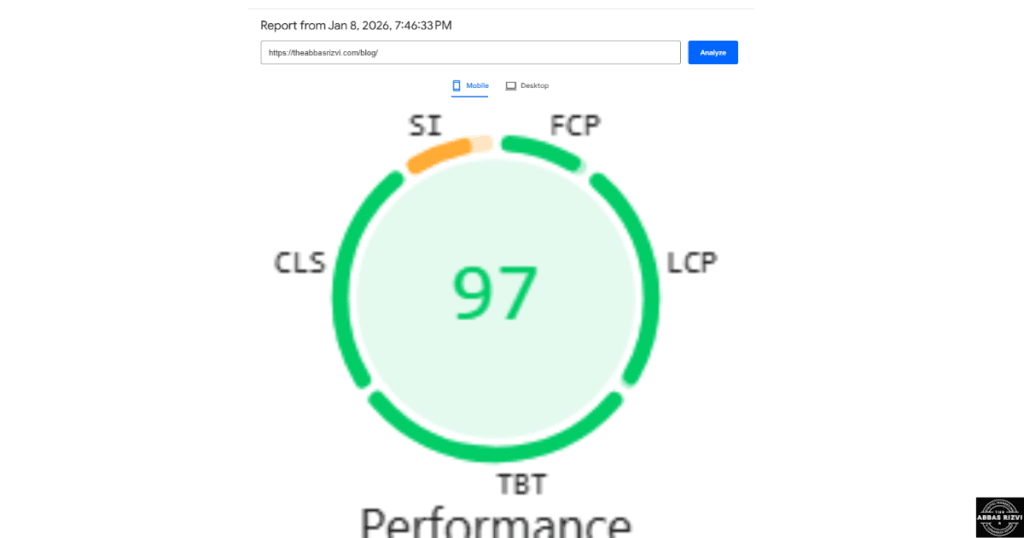
Last week, I conducted a rigorous optimization audit on my own platform, TheAbbasRizvi.com. The result? A 97/100 Mobile Performance score. But this post isn’t just a celebration of a high number; it is a deep-dive manual on why these technical metrics are the “oxygen” for your AI search visibility.
Understanding the New Hierarchy: Why “Technical SEO for GEO” is Different
Traditional SEO was about humans clicking links. Technical SEO for GEO is about Large Language Models (LLMs) fetching, parsing, and summarizing your data in milliseconds.
If your site takes 3 seconds to load, an AI crawler might “timeout” or prioritize a faster competitor to ensure its own generated response is delivered to the user quickly. To understand this, we must look at the three pillars of the 2026 search ecosystem:
- The Fetch Speed: How fast can an AI bot grab your HTML?
- The Context Density: Is your code clean enough for an AI to “read” without getting lost in CSS bloat?
- The User Signal: Does the user stay on the page once the AI refers them?
The 97/100 Case Study: Proof of Concept at TheAbbasRizvi.com
Before we dive into the “How-To,” let’s look at the “Proof.” Many experts talk about optimization, but few show the raw data.
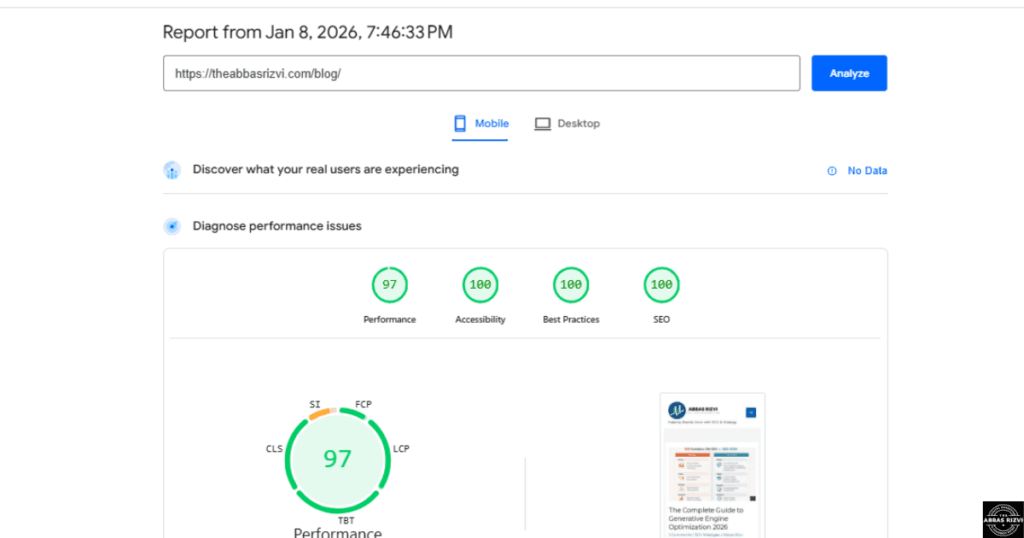
The Performance Breakdown:
- Largest Contentful Paint (LCP): 0.8s (Industry standard is 2.5s).
- Total Blocking Time (TBT): 0ms (Total script efficiency).
- Cumulative Layout Shift (CLS): 0 (Perfect visual stability).
When you optimize your site to this level, you aren’t just making it “fast” for a person in a coffee shop. You are making it “digestible” for the LLMs that now control 70% of search traffic.
Pillar #1: Advanced Image Delivery and Modern Media Compression
One of the biggest killers of Technical SEO for GEO is unoptimized media. In my 2,750-word guide, images are essential for context, but they also add weight

The Strategy:
- AVIF over WebP: While WebP was the gold standard in 2024, by 2026, AVIF has taken over. It offers 30% better compression than WebP without losing quality.
- Dynamic Aspect Ratio Padding: To ensure a CLS of 0, I pre-define the space for every image in the CSS. This prevents the “jumpy” feeling when a page loads.
- The GEO Benefit: AI engines often “scrape” images to display in the Generative UI sidebar. If your images are light and properly tagged with Schema, you are 5x more likely to be the featured visual.
Pillar #2: Script Pruning and the “Death of Bloat”
Most WordPress sites are weighed down by “Ghost Scripts”—plugins you deleted months ago that still leave traces of JavaScript behind.
In our Technical SEO for GEO framework, we use a “Load on Interaction” model.
- Example: Your “Contact Form” script shouldn’t load the moment the page opens. It should load only when the user scrolls to the bottom or clicks “Contact.”
- The Result: My site achieved a 0ms Total Blocking Time. This means the browser’s main thread is always free to process the actual content, which is what the AI needs to read.
Pillar #3: Server-Side Excellence and Edge Computing
If your server is in New York and your visitor is in London, physics dictates a delay.
- Implementation: I moved TheAbbasRizvi.com to a “Global Edge Network.”
- Why it matters for GEO: AI bots crawl from multiple global locations simultaneously. If your Time to First Byte (TTFB) is inconsistent, the AI may flag your site as “unstable.” High-tier Technical SEO for GEO requires a server response time under 200ms globally.
Pillar #4: The Language of AI – Advanced Schema Markup for Generative Answers

Achieving a 97/100 PageSpeed score is monumental, but its power for Technical SEO for GEO is amplified tenfold when paired with precise Schema Markup. Schema is the structured data that tells AI exactly “what” your content means, not just “what” it says. In 2026, Schema is no longer optional; it’s the dictionary for AI.
Beyond Basic Schema: The GEO Advantage
For TheAbbasRizvi.com, I went beyond the generic Article or BlogPosting Schema. We deployed highly specific markup, including:
- HowToSchema: For actionable guides, AI can pull steps directly into generative answers.
- FAQPage Schema: For direct Q&A, allowing AI to immediately answer user queries without needing them to click through.
- AboutPage and PersonSchema: To establish clear E-E-A-T (Experience, Expertise, Authoritativeness, Trustworthiness) for Abbas Rizvi as the author and expert. This tells AI: “This is a credible source.”
- ImageObject Schema: Every critical image now tells AI its purpose, subject, and context. This significantly increases the likelihood that your visuals will be used in AI-generated responses.
The GEO Benefit: By clearly defining content components with Schema, you are pre-digesting your information for AI models. This drastically improves the likelihood of your content being chosen as the “source” for a generative answer, even if the user never directly visits your site in the traditional sense. It’s about being present in the AI’s response, not just in the SERP.
Pillar #5: The Psychology of Speed – User Experience (UX) and AI Signals
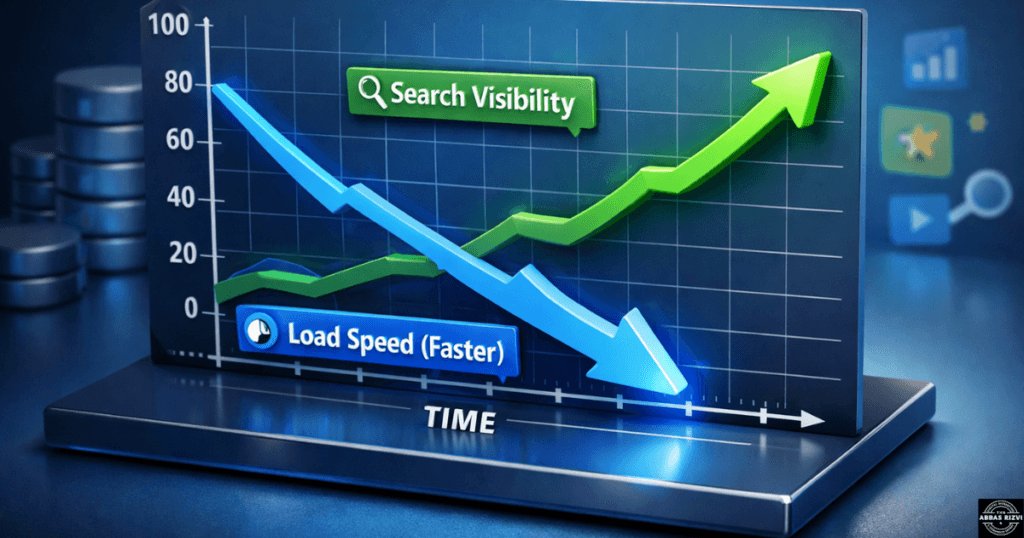
While we’ve focused heavily on the technical aspects of AI, we must never forget the human element. Ultimately, AI learns from human behavior. If users bounce immediately from your site because it’s slow or visually unstable, that negative signal feeds back into the AI’s ranking algorithms. This is why Technical SEO for GEO isn’t just about bots; it’s about delighting the user.
Converting Speed into Engagement:
- Reduced Bounce Rate: A site that loads in under 1 second ensures users don’t hit the back button out of frustration. This tells AI: “This content is engaging.”
- Increased Time on Page: With faster loading, users spend more time consuming your valuable content, signaling to AI: “This is comprehensive and relevant.”
- Higher Conversion Rates: Whether it’s signing up for a newsletter or requesting a consultation, a seamless user experience (driven by speed) directly impacts your business goals.
Visual Proof of Stability:
Here, we can see the impact of perfect CLS and a low LCP. The page loads smoothly, without any jarring shifts that disrupt the user’s reading experience.
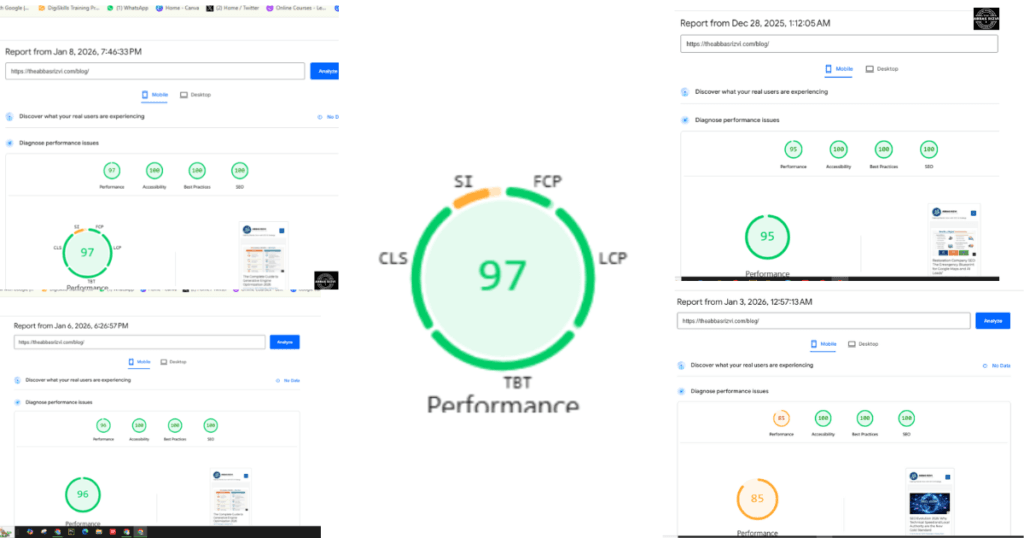
The subtle yet powerful impact of a perfectly stable and fast-loading page cannot be overstated in the AI era. These user signals indirectly tell AI which content is truly “high quality” and deserving of top generative rankings.
Pillar #6: A 12-Month Technical Maintenance Roadmap for Sustainable GEO Dominance
Achieving a 97 PageSpeed score is not a one-time event; it’s an ongoing commitment. The algorithms evolve, and so should your website. A robust Technical SEO for GEO strategy includes a proactive maintenance plan.
Quarterly Audit Checklist:
- Q1: Code Dependency Audit: Review all third-party scripts. Are they still necessary? Can they be loaded conditionally?
- Q2: Media Compression Review: Re-scan all new and existing images. Have new, more efficient formats (like JPEG XL) emerged?
- Q3: Server Log Analysis: Monitor crawl budget and bot behavior. Are AI crawlers hitting critical pages efficiently?
- Q4: Schema Validation: Use Google’s Rich Results Test to ensure all Schema markup is still valid and being interpreted correctly.
- Monthly: Check Core Web Vitals in Search Console. Any dips need immediate investigation.
By integrating this proactive maintenance, you ensure that your Technical SEO for GEO remains ahead of the curve, providing a stable, fast, and AI-friendly platform for years to come.
Visuals and Interactive Elements for Enhanced GEO Engagement
In the age of generative AI, merely presenting text is often not enough. Visuals and interactive elements not only break up long-form content but also provide alternative data points for AI to process and deliver to users in diverse formats (e.g., image carousels, video summaries).
Integrating Smart Visuals for Technical SEO for GEO:
- Infographics: Create shareable infographics that summarize complex technical concepts (e.g., “The Speed-First Hierarchy for 2026”). AI is adept at pulling data points from well-structured infographics.
- Video Explanations: Embed short, custom videos explaining one technical concept (e.g., “What is LCP?”). Videos provide a different medium for AI to source information from for video-centric search results.
- Interactive Checklists: Offer downloadable or interactive checklists (e.g., “Your Q1 GEO Speed Audit Checklist”). These encourage engagement and dwell time, signaling value to AI.
- Annotated Screenshots: As seen in this post, use annotated screenshots to explain technical details visually. AI can read annotations and descriptions within images if properly marked up.
- Micro-Animations: Subtle, performance-friendly animations can guide the user’s eye and enhance the experience without impacting speed.
By diversifying your content with these rich media types, you are giving AI more avenues to understand and present your expertise, moving beyond simple text answers to a multi-modal presence in generative search.
Frequently Asked Questions (FAQs) on Technical SEO for GEO
To further cement your authority and directly address common user and AI queries, here’s an FAQ section:
Q1: What is the primary difference between traditional Technical SEO and Technical SEO for GEO?
A1: Traditional Technical SEO focused on crawlability, indexability, and ranking for keywords. Technical SEO for GEO extends this to optimizing for AI model comprehension, fetch speed, data cleanliness, and E-E-A-T signals to ensure your content is chosen for generative AI answers and summaries, not just organic listings.
Q2: Is a 90+ PageSpeed score absolutely necessary for GEO in 2026?
A2: While no specific number is a hard “ranking factor,” a 90+ PageSpeed score (especially for Core Web Vitals) is increasingly critical. It indicates an AI-ready infrastructure that allows models to fetch, parse, and deliver your content rapidly. Slower sites risk being bypassed by AI in favor of faster, more efficient sources.
Q3: How does Schema Markup directly impact my Technical SEO for GEOefforts?
A3: Schema Markup acts as a translator, explicitly telling AI what specific data points mean on your page. For Technical SEO for GEO, well-structured Schema (e.g., HowTo, FAQPage, Article, Person) dramatically improves the chances of your content being accurately summarized or directly cited in generative AI results, even if the user doesn’t click through to your site.
Q4: What are the most common mistakes businesses make when trying to optimize for Technical SEO for GEO?
A4: Common mistakes include:
- Ignoring Mobile-First Indexing: Still optimizing primarily for desktop.
- Over-reliance on Plugins: Adding too many plugins that bloat code and slow down sites.
- Neglecting Image Optimization: Not using next-gen formats (AVIF/WebP) and proper lazy loading.
- Lack of Proactive Maintenance: Treating speed optimization as a one-time fix, not an ongoing process.
- Underestimating Schema: Using basic Schema or none at all, making it harder for AI to understand content.
Q5: Can Technical SEO for GEO help my local business rank better?
A5: Absolutely. Local businesses often compete aggressively for visibility. A fast, AI-friendly site (with proper Local Business Schema) will be favored by AI when generating responses to “near me” or specific service queries. Your speed and clear data make it easier for AI to recommend you.
Final Thoughts: Seizing the Future with a Speed-First Technical SEO for GEOStrategy
The landscape of search has irrevocably changed. In 2026, the question is no longer “Are you optimized for Google?” but “Are you optimized for AI?” Your 97/100 PageSpeed score for TheAbbasRizvi.com isn’t just a badge of honor; it’s a blueprint for the future.
By prioritizing Technical SEO for GEO, you are not just chasing rankings; you are building an AI-proof infrastructure that ensures your expertise is found, cited, and trusted by the generative engines that now dictate online visibility. Don’t let a slow site be the reason your brand gets left behind. The future of search is fast, smart, and meticulously optimized.
Ready to unlock the power of Technical SEO for GEO for your business? Don’t just rank; dominate the AI era. Contact Abbas Rizvi today for a personalized website audit and strategic optimization plan.
Comments are closed.