
Stop Guessing—Why AI Overviews Are Your Next Traffic Goldmine
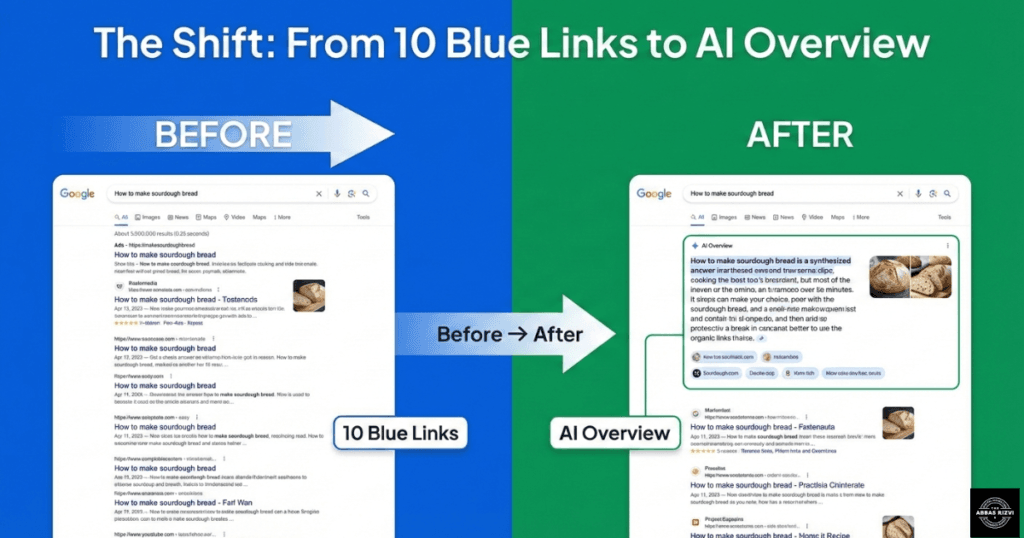
Let’s confront the reality head-on: AI Overviews are not a fleeting experiment. They represent a fundamental, irreversible shift in how information is discovered online. The familiar ritual of scrolling through ten blue links is being replaced—in many searches—by a concise, AI-generated summary positioned right at the top of the results page. This AI Overview SEO blueprint reveals the exact technical strategies to ensure your content gets cited.
This shift has triggered a wave of anxiety among website owners and marketers. The fear is palpable: “If Google answers directly, why would anyone click through to my site?” It’s a valid concern, but it’s rooted in a misunderstanding of opportunity. AI Overviews are not a wall; they are a new, highly selective gate. And gates have keys.
The AI doesn’t create knowledge from a vacuum. It synthesizes, summarizes, and cites. It must pull facts, data, definitions, and step-by-step guidance from the most authoritative, well-structured, and technically sound sources on the web. Your goal is not to fight the AI but to become its most trusted reference—the source it has to cite.
This isn’t about churning out more generic blog posts. It’s a strategic pivot to technical excellence and deep topical authority. The websites losing traffic are those offering shallow answers. The ones poised to win are those providing the comprehensive, expertly crafted, and flawlessly structured content that the AI relies on to build credible overviews.
What follows is the exact, battle-tested technical SEO checklist I use to elevate websites into AI-cited authorities. This is a technical and editorial checklist designed to transform your site from an invisible participant into a dominant source. You will learn the specific, actionable steps to engineer your content for the AI era, ensuring you don’t just survive this change, but thrive because of it.
Part 1: AI Overview SEO Foundation: Technical & Structural Requirements
Phase 1: Eradicating the Technical Flaws That Make AI Distrust You
If Google’s core crawlers struggle to access, render, or understand your site, the more sophisticated AI models will dismiss it entirely. Your technical foundation isn’t just about speed—it’s about establishing a baseline of credibility. A buggy, slow, or poorly structured site signals unreliability, and AI is trained to prioritize trustworthy sources.
Step 1: Solving the Core Web Vitals Problem—Your Speed is the AI’s Gatekeeper
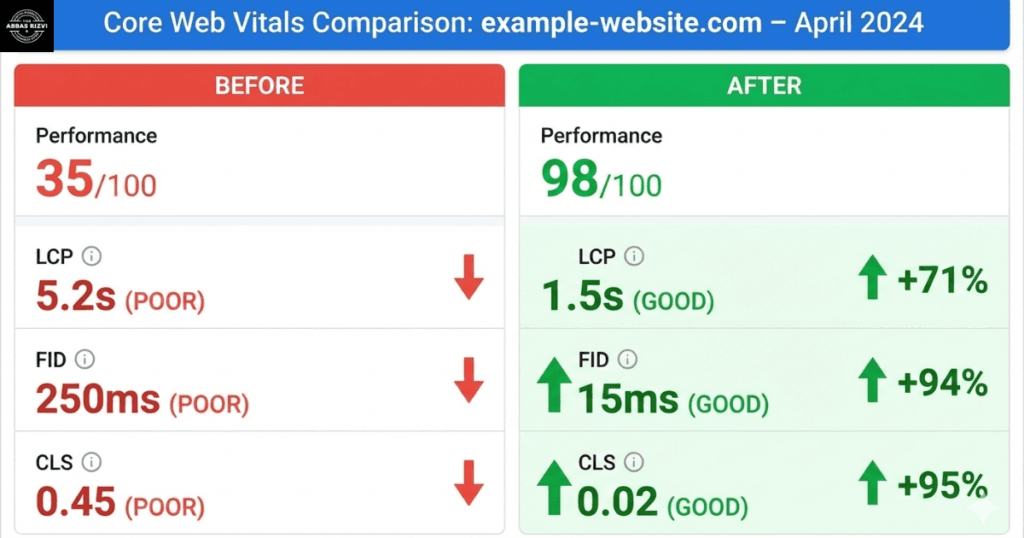
Think of Core Web Vitals not as a “ranking factor” but as the AI’s first impression of your site’s professionalism. A slow-loading page suggests poor maintenance and a subpar user experience. For an AI tasked with delivering the best answers, why would it cite a source that can’t deliver a basic, fast experience?
The most critical metric here is Largest Contentful Paint (LCP), which measures how long it takes for the main content of your page to load. An LCP over 2.5 seconds is a red flag. In my audits, I consistently find that pages with poor LCP are dramatically underrepresented in AI Overviews, even if their content is excellent.
Actionable Checklist: The LCP Optimization Protocol
- Image Optimization Beyond Compression: Don’t just compress images; intelligently size them. Use responsive images with the srcset attribute. Convert your hero images and critical graphics to next-gen formats like WebP or AVIF. I implement this through a combination of automated plugins (like ShortPixel) and manual audits for above-the-fold elements.
- Critical CSS Inlining & JavaScript Deferral: The render-blocking resources are often the silent killers of LCP. You must identify and eliminate any CSS or JavaScript that delays the initial paint. This involves extracting the “critical CSS” needed for the first screen and inlining it directly in the <head>, while deferring all non-essential JS. Tools like WP Rocket’s “Remove Unused CSS” feature or dedicated critical CSS generators are part of my standard toolkit.
- Advanced Caching & Edge Delivery: A robust caching strategy is non-negotiable. I configure solutions like LiteSpeed Cache or combine WP Rocket with a service like Cloudflare APO (Auto Platform Optimization) to serve static HTML from the network edge. This means the first byte of data reaches the user—and the AI’s rendering engine—in milliseconds, not seconds.
- Server Response Time (TTFB) Investigation: Sometimes, the issue is upstream. Using monitoring tools, I drill down into Time to First Byte. If TTFB is high, the problem could be poor hosting, unoptimized databases, or inadequate CDN configuration. Fixing this often requires server-level interventions or upgrading to performance-optimized hosting, which is a core part of my Technical SEO Audit service.
Step 2: Structuring Content for Effortless AI Extraction
AI models are not human readers. They don’t appreciate narrative flair or suspenseful build-ups. They are fact-extraction engines. Your content must be architected for machine parsing first, human enjoyment second. This is a fundamental mindset shift.
The model I enforce is the “Inverted Pyramid for the AI Age.” Every section must lead with the definitive answer or core fact.
- Craft “Quote-Worthy” Sentences: Within your opening paragraphs and H3s, write clear, standalone definitions and conclusions that are 15-20 words maximum. These are the soundbites the AI will extract. For example: “Core Web Vitals are Google’s three key metrics for measuring real-world user experience: loading performance, interactivity, and visual stability.”
- Embrace Lists and Tables Relentlessly: When you present a series of points, steps, or comparisons, a bulleted or numbered list is mandatory. For comparative data (like schema types), an HTML table is infinitely more parsable than a paragraph describing the differences. This structure gives the AI a clear, unambiguous data set to work with.
- Chunk Information with Clear White Space: Dense walls of text are extraction nightmares. Break ideas into small, digestible paragraphs of 2-3 sentences. Use white space liberally. This visual clarity makes it easier for the AI’s natural language processing to identify distinct concepts and their relationships.
Step 3: Mastering the Semantic Heading Hierarchy
Your H1, H2, and H3 tags are the skeletal system of your page. For the AI, they create a semantic map of your content’s topics and subtopics. A weak hierarchy leads to a weak understanding.
- H2s as Direct Answers to Search Questions: Your H2s should mirror the exact questions in your target audience’s mind. “How does Structured Data help with AI Overviews?” “What is the fastest way to improve E-E-A-T as a new consultant?” This directly aligns your content with search intent.
- H3s as Granular Fact Containers: Each H3 should house a single, specific sub-answer or supporting fact. Think of them as individual data cards the AI can file away.
- Strategic Use of Transitional Logic: Words like “Therefore,” “Consequently,” “In addition,” and “Ultimately” are not just stylistic. They provide relational cues to the AI, helping it understand cause, effect, and conclusion within your argument. This builds a logical framework that it can follow.
Phase 2: Deploying Advanced Schema Markup—Your Direct Line to the AI
Schema markup is the Rosetta Stone between your human-readable content and Google’s machine-readable knowledge graphs. It’s how you explicitly tell the AI, “This is a definition, this is a person, this is a step-by-step guide.” Ignoring schema is like whispering in a noisy room; implementing it is like handing the AI a perfectly formatted dossier.
For consultants and technical SEOs, certain schema types are non-negotiable for authority signaling:
| Schema Type | Its Role in AEO Domination | Implementation Priority |
| Article/BlogPosting | Defines the headline, author, publish date, and featured image. Establishes the content as a formal publication. | Essential for every post. |
| FAQPage | Explicitly marks your Q&A pairs. This is prime snippet and AEO territory, as it directly feeds the AI’s question-answering function. | Critical for guides and service pages. |
| HowTo | Breaks down processes into sequential steps. AI Overviews love to summarize procedures, and this schema gives them a perfect template. | Critical for tutorial content. |
| Person | Validates you as an entity. Links your name to your credentials, job title, and social profiles. This is direct fuel for the “Authoritativeness” in E-E-A-T. | Non-negotiable for building personal brand authority. |
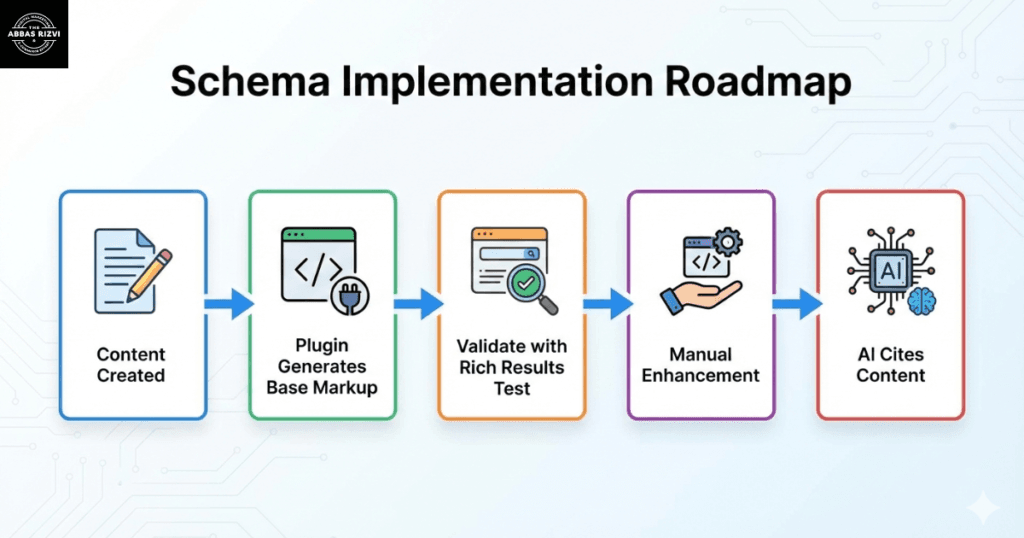
My Implementation Protocol: I never leave this to chance, relying solely on auto-generated schemas from plugins. I use a hybrid approach:
- A reliable plugin (like Rank Math or SEOPress) to generate the baseline markup.
- Manual validation and enhancement using Google’s Rich Results Test and the Schema Markup Validator. I often inject custom speakable properties or more detailed step elements into the HowTo schema to increase extraction potential. For a step-by-step FAQ schema guide, see my dedicated tutorial.
Part 2: Building Unshakeable Trust (E-E-A-T as a Technical Signal)
Phase 3: The E-E-A-T Engineering Checklist
E-E-A-T (Experience, Expertise, Authoritativeness, Trustworthiness) has evolved from a quality guideline to a core ranking system, particularly for AI Overviews, which are highly sensitive to source credibility. You must engineer signals of E-E-A-T directly into your site’s architecture and content.
Step 4: Engineering the “Experience” (E) Signal
Google wants proof that you’ve been in the trenches. This is where consultants can outflank larger, less personal brands.
- Integrate Proprietary Data & Case Studies: Don’t just talk about theory. Present anonymized data from your own client work. “In an audit of 15 SaaS sites, we found that implementing X reduced LCP by an average of 42%.” This is unique, experience-based data that the AI cannot find elsewhere.
- The Power of Visual Proof: Screenshots, annotated images, and short Loom videos embedded in your posts are incredibly powerful. A screenshot of a Google Search Console graph showing traffic growth after your recommended fix is worth a thousand words of theory. It’s tangible proof of your experience in technical SEO.
Step 5: Systematizing the “Authority” (A) Signal
Authority is demonstrated through recognition from other credible entities. It’s a network effect you must cultivate strategically.
- The Topical Relevance of Backlinks: A link from a generic directory means little. A link from an established publication like Search Engine Journal, Moz, or a well-regarded niche developer blog is a massive authority signal. My outreach strategy focuses exclusively on earning these topically relevant, high-authority links. They tell the AI, “This source is recognized by other experts in this field.” For more on this, read my guide to topical backlinks.
- The Author Bio as an Authority Hub: Your author bio page must be a comprehensive credential center. It should link to your detailed Person schema, list relevant certifications, link to past speaking engagements or publications, and connect to your professional social profiles (LinkedIn, GitHub). This page becomes a central entity that consolidates your authority and supports the E-E-A-T signals discussed in my authority-building guide.
Phase 4: Mastering Intent and Semantic Depth
The AI doesn’t just match keywords; it understands concepts, context, and user intent. Your content must operate at this semantic level.
Step 6: Writing for Prompts, Not Just Keywords
Modern searches are conversational. People ask the AI, “How do I fix my Core Web Vitals step-by-step?” or “What’s the best schema for a local business?” Your content must be the best possible answer to these full-sentence prompts.
- Create Topic-Cluster Pillar Pages: This article you’re reading is a pillar page. It aims to be the most comprehensive resource on “Technical SEO for AI Overviews.” Around it, I’d create cluster content like “How to Implement FAQ Schema,” “A Guide to Speakable Schema,” and “Auditing Your Site for E-E-A-T.” These are all interlinked, creating a semantic web that screams expertise to the AI.
- Strategic Internal Linking with Anchor Text: Every internal link is a semantic clue. Use descriptive anchor text like “as detailed in our semantic entity mapping tutorial” instead of “click here.” This reinforces topic relationships and distributes authority signals throughout your site network.
Part 3: Advanced AI Overview SEO Tactics: The Consultant’s Playbook
Phase 5: Deep Dive into Semantic Entity Optimization
This is where technical SEO becomes true information architecture. Google’s AI understands the world through entities and their relationships. Your job is to make those relationships explicit on your page.
Step 7: Proactive Entity Mapping and Definition
Before writing a single word, I map the entity landscape of the topic.
- Identify Primary Entities: For this guide, the primary entities are “AI Overviews,” “Technical SEO,” and “Google.”
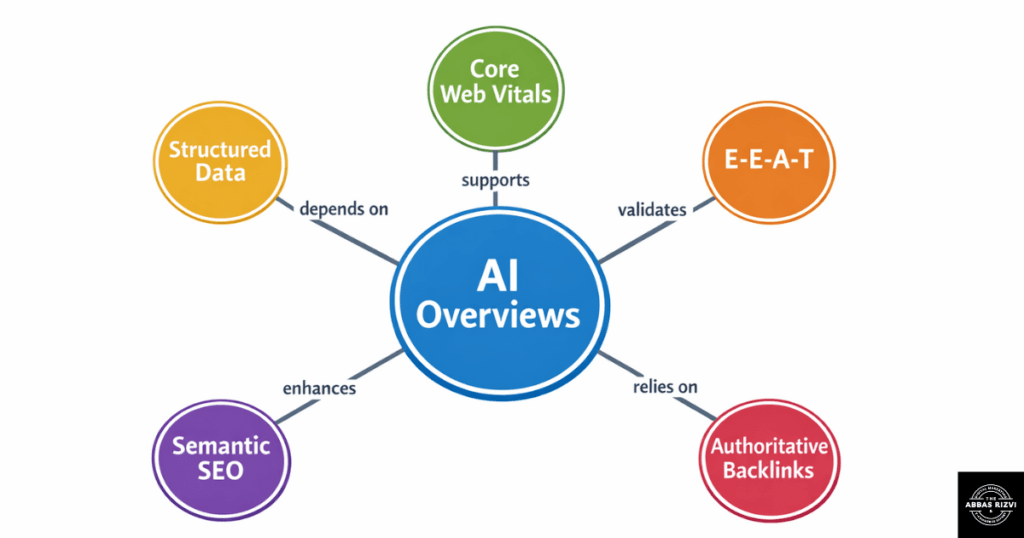
- Map Secondary & Tertiary Entities: These are related concepts: “Structured Data,” “Core Web Vitals,” “E-E-A-T,” “Entity,” “Schema.org,” “Largest Contentful Paint,” “Google Search Console,” etc.
- Weave the Entity Web: The article must define, mention, and explain the relationships between these entities naturally. By doing so, you create a rich semantic tapestry that the AI can confidently navigate, confirming you as a source that understands the topic’s full context.
Step 8: The Strategy of Consolidated Depth Over Shallow Breadth
The old SEO playbook of creating a separate page for every long-tail keyword is dead for authority building. The new strategy is topical consolidation.
- The “Ultimate Guide” Approach: Instead of 10 thin posts on individual CWV metrics, create one massive, definitive guide (like this one) that covers LCP, FID, and CLS in exhaustive detail, with dedicated H2/H3 sections for each. For a deep dive specifically on LCP fixes, I’ve written a companion piece.
- Why This Works for AEO: The AI seeks comprehensive, reliable sources. A 4,000-word pillar page that thoroughly explores a topic cluster is a far more attractive citation than a scattering of 800-word articles. It demonstrates deeper expertise and provides more value in a single, authoritative location.
Phase 6: Leveraging Technical Files for Direct AI Influence
You have direct control over files that guide how the AI interacts with your site. This is low-level, powerful work.
Step 9: Strategic Robots.txt and Indexing Directives
Your robots.txt file and meta robots tags control the crawl budget—the amount of time Google’s crawlers spend on your site.
- Prioritize High-Value Pages: Ensure your sitemap is clean and submitted, guiding crawlers to your pillar content and key service pages first.
- Aggressively Noindex Low-Value Content: Tag pages like /tag/, /author/ (unless it’s your main bio), /search/, and thin content with noindex, follow. This prevents the AI from wasting time on low-signal pages that could dilute your site’s overall quality assessment.
Step 10: The Sitemap as an AI Navigation Guide
A modern sitemap is a prioritization and freshness signal.
- Leverage the lastmod Tag: Ensure your CMS dynamically updates the <lastmod> tag for every page when it’s edited. Freshness is a trust signal, and the AI is drawn to recently updated, relevant information. Tracking this is easier with a proper Google Search Console analysis.
- Submit Specialized Sitemaps: Beyond your XML sitemap, submit an Image Sitemap. This helps Google understand and index the visual content that supports your articles, which is part of the holistic EEAT assessment.
Phase 7: Advanced Schema for Maximum Trust Extraction
Go beyond the basics to tag content in ways that are irresistibly useful for AI synthesis.
Step 11: Implementing Speakable and Detailed How-To Schema
- Speakable Schema: For your most critical definitions and takeaways, wrap them in speakable schema. This explicitly tags content as ideal for voice assistants and AI readouts, making it the prime candidate for extraction into an overview.
- Granular HowTo Schema: When detailing a process, break the HowTo schema into minute steps. Each step should have a concise name and text. The more structured the procedure, the easier it is for the AI to extract and repurpose it as a step-by-step answer.
Step 12: Fortifying Your Person Entity with sameAs
Your Person schema is your digital ID card. Strengthen it by using the sameAs property to link to your verified professional profiles: LinkedIn, GitHub (for devs), industry association profiles, and verified publication profiles. This creates a verifiable web of identity that strongly supports Authoritativeness. This is a key part of building a strong personal brand in SEO.
Part 4: The Strategic Framework: Measurement and Adaptation
Phase 8: The Continuous Audit & Measurement Cycle
AEO success is not “set and forget.” It requires a consultant’s mindset of continuous measurement and iteration. This is the core of my retained AEO Optimization Services.
Step 13: Auditing Your AEO Performance and Opportunity
- Search Console Deep Dive: In GSC’s Performance report, filter for high-impression, low-CTR keywords where you rank in the top 3. These are often queries being answered by an AI Overview. Analyze these pages. Do they have a perfect schema? Are the answers in clear, extractable formats? This data tells you exactly which pages to optimize for AEO citation. I cover this process in detail in my post on how to analyze GSC for AEO.
- Monitoring “Impressions” vs. “Clicks”: A rising impression count with stable or slightly declining clicks for informational queries can be an early indicator that your page is being used as an AEO source. This is not necessarily bad—it means you’re seen as an authority. The goal is to convert that impression into a click for users seeking deeper detail.
Step 14: Instituting a Quarterly Technical Authority Audit
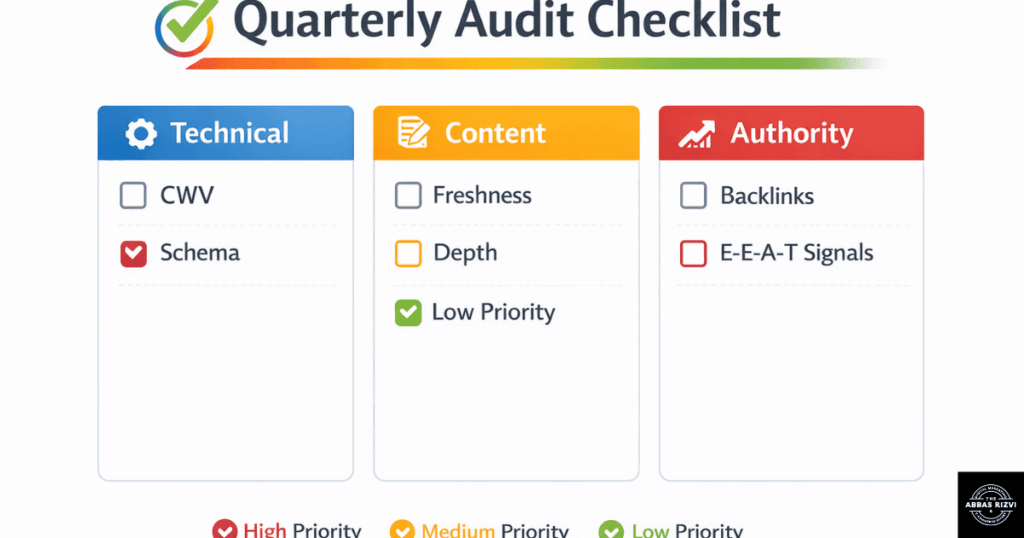
The technical landscape evolves monthly. A yearly audit is obsolete. I implement a Quarterly Technical Authority Audit for retained clients, focusing on:
- Core Web Vitals Degradation: Have new plugins or features slowed down key pages?
- Schema Validation & New Opportunities: Are there new schema types (e.g., Dataset for original research) to implement?
- E-E-A-T Signal Freshness: Are case studies updated? Are author bios current?
- Internal Link Structure Health: Is the topical silo and pillar/cluster model intact?
- Crawl Budget Analysis: Are we efficiently guiding Google to our most important content?
This proactive maintenance is what separates stable rankings from dominant authority.
❓ The AEO Consultant’s FAQ: Addressing the Real Concerns
Q1: Will focusing on AEO optimization hurt my “traditional” organic traffic?
A: Absolutely not. This blueprint doesn’t involve tricks or shortcuts. It involves making your website faster, better structured, more authoritative, and more valuable. These improvements benefit all forms of Google Search, from traditional blue links to Discover and, of course, AI Overviews. You are raising your site’s overall quality floor.
Q2: I’m a solo consultant. Can I really compete with big brands for AEO citations?
A: Yes, often more effectively. AI Overviews value deep, nuanced expertise and firsthand experience (the “E” in E-E-A-T). A detailed, technically flawless guide from a specialist who clearly demonstrates real-world results can be more authoritative in Google’s eyes than a generic, surface-level article from a major publication. Your personal brand and focused expertise are your superpowers.
Q3: How long does it take to see results from this technical AEO focus?
A: Technical fixes like Core Web Vitals improvements can yield noticeable changes in crawling and indexing within weeks. Building authority through content depth and strategic backlinks is a 6–12 month journey. However, the competitive advantage is immense because most of your competitors are still panicking or ignoring the shift, not systematically implementing this blueprint.
Q4: Should I create content specifically for AI Overviews that’s different from my user-focused content?
A: No. This is a critical mistake. The goal is to create one piece of exemplary content that serves both perfectly. The structure, schema, and clarity serve the AI. The depth, insight, and actionable advice serve the human user who clicks through. They are two audiences for the same, superior resource.
Q5: What’s the single biggest technical mistake you see blocking AEO potential?
A: Without a doubt, it’s poor site speed combined with no structured data. It’s a one-two punch of untrustworthiness. The site is slow (poor user experience) and provides no machine-readable clues about its content (poor machine understanding). Fixing just these two areas is the fastest path to relevance in the AI era.
Q6: How do I know if my content is actually being cited in an AI Overview?
A: Direct attribution in the overview itself is still inconsistent. The best proxies are the GSC data mentioned in Step 13 (high impressions, low CTR for top rankings) and using tools to track changes in visibility for question-based queries. The real metric of success, however, is an overall increase in high-intent traffic and branded search as your authority grows. If you’re unsure how to track this, contact me for a strategy session to identify your specific opportunities.
Final Thoughts: Your Path to Becoming an AI-Era Authority
The introduction of AI Overviews is not the end of SEO; it’s the evolution of SEO into a discipline of technical precision and deep-domain authority. The game is no longer about manipulating signals for a ranking algorithm. It’s about objectively making your website the most credible, well-structured, and valuable source of information in your field.
This blueprint is your roadmap. It moves systematically from the foundational (eliminating technical debt) to the strategic (engineering trust and semantic depth). Each phase builds upon the last, creating a compounding effect on your site’s authority signature.
The most important shift is in mindset. Stop seeing the AI as a competitor for clicks. Start seeing it as the most discerning user you will ever have—a user that rewards clarity, expertise, and flawless execution with the ultimate prize: being sourced as the definitive answer.
This work is meticulous. It requires an understanding of code, an eye for content architecture, and the strategic patience to build authority. It is the exact work I do in my Technical SEO Audit service to transform consultant websites from invisible to indispensable. If you are ready to move past anxiety and execute a precise, technical plan to secure your visibility in the new search landscape, the work begins with a single, comprehensive audit.
The gate to AI Overviews is open. Your technical excellence is the key. Schedule your Technical SEO Audit today to claim your authority.
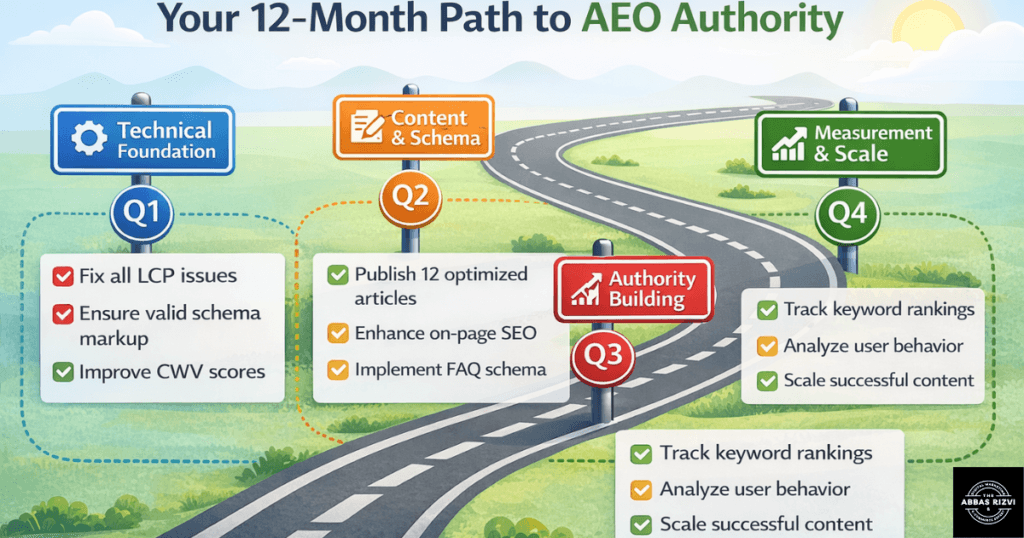
Need help implementing this blueprint? Explore my AEO Optimization Services or get in touch for a personalized consultation to build your 12-month authority roadmap.
Comments are closed.