
The Hidden Crisis: Why Your Search Traffic is “Ghosting” You
Implementing a Generative Engine Optimization (GEO) Strategy is now the only way to survive the shift from traditional search to AI-driven answers. For over a decade, the “Golden Rule” of digital growth was simple: Rank on page one, and the clicks will follow.
But as we move further into 2026, many of you are witnessing a terrifying trend. Your rankings are holding steady at positions 1, 2, or 3, yet your organic traffic in Google Search Console is bleeding out.
You aren’t losing to competitors; you are losing to the interface itself.
Enter the era of the Zero-Click Search. With the full integration of Search Generative Experience (SGE) and AI-driven snapshots, Google is no longer a “search engine” that points people to websites—it has become an “answer engine” that synthesizes your content and presents it as its own.
The Pain Point is Real: When a user asks a complex question about your industry, Google AI pulls the answer from your hard-earned article, displays it in a beautiful 400-word summary, and the user leaves without ever visiting your site. Your “Brand Authority” is being used to train the very AI that is replacing your traffic.
The Solution: Moving from SEO to GEO
If you continue to optimize for “Blue Links,” you are building a strategy for a world that no longer exists. To survive the next 24 months, you must master Generative Engine Optimization (GEO).
GEO is not about keyword density or meta tags. It is a sophisticated technical and psychological framework designed to make your brand “un-ignorable” to AI models like Gemini, ChatGPT, and Claude. In this 2,000-word masterclass, I am going to break down the exact GEO strategy I use to ensure that even when AI summarizes my content, it is forced to cite my brand as the primary source of truth.
The “Information Gain” Secret: How to Outsmart the AI Echo Chamber
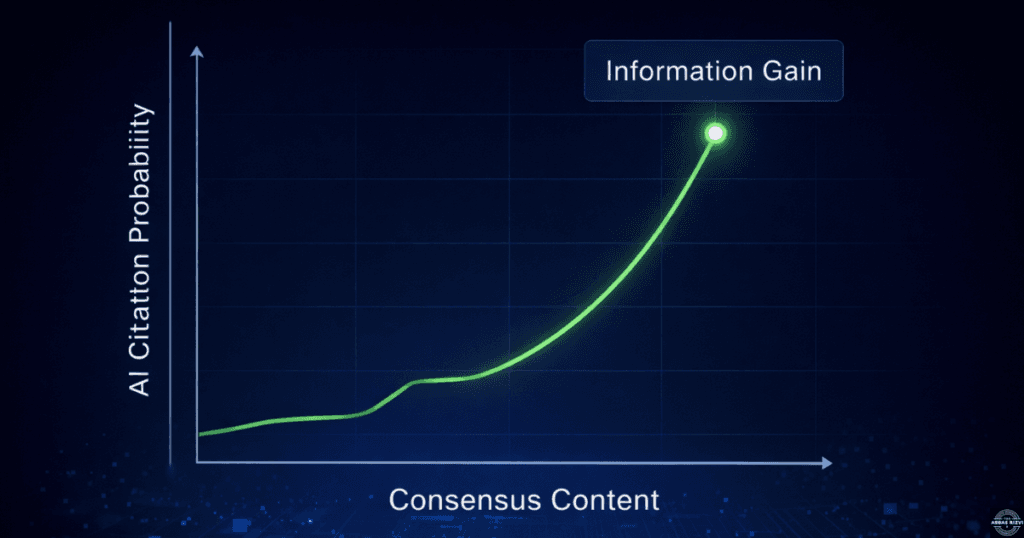
One of the biggest mistakes I see in 2026 is “Consensus Content.” Most bloggers use AI to write about AI. They scrape the top 10 results, reword them, and hit publish. To a Generative Engine, this content is worthless. It has high “Perplexity” but zero “Information Gain.”
What is Information Gain? In simple terms, it is the unique value your content provides that cannot be found anywhere else on the web. Google’s latest patents suggest it is now measuring the “Novelty Score” of an article. If your article provides the same facts as Wikipedia or a major news site, the AI will summarize it and credit the bigger site.
How to Inject Information Gain into Your Articles:
- The “Proprietary Data” Method: Stop quoting other people’s stats. Use your own. For example, in my recent technical audit, I didn’t just say “PageSpeed matters.” I documented the exact impact of LiteSpeed optimization on a 2,750-word guide. This “raw data” is like catnip for AI bots. They need facts to be accurate, and when you provide unique facts, you become a Primary Entity.
- The “Contrarian Angle”: AI is trained on the “average” opinion. If you provide a well-reasoned, expert perspective that challenges the consensus, you trigger a “Diversity Signal” in the algorithm. AI engines love to show “multiple perspectives,” and being the lone expert voice ensures you get cited in the “Perspectives” tab of Google.
- The “Axiom” Strategy: Create your own terminology. Instead of talking about “good branding,” I talk about “Epistemic Authority.” When you create a new term for a known problem, and people start searching for it, you own the entire search vertical for that “Entity.”
Building a “Machine-Readable” Foundation
In the traditional SEO era, we built websites for humans and “crawlers.” In the 2026 GEO era, we are building for Large Language Models (LLMs). These models don’t just “read” your text; they “vectorize” it—breaking it down into mathematical relationships between concepts.
If your website’s code is messy or lacks structure, the AI has to “guess” your meaning. And in AI search, a guess is a missed citation. To ensure your content is the one chosen for an AI Overview, you must master the following three technical pillars.
1. Semantic HTML5: The “Skeleton” of Your Content
Stop using generic <div> tags for everything. AI scrapers (like the ones used by OpenAI and Perplexity) use Semantic HTML to understand the hierarchy of information.
- The <article> Tag: Your main blog post should always be wrapped in this. It signals that this is a standalone piece of knowledge.
- The <main> Landmark: Tells the AI exactly where the “meat” of the page starts, ignoring sidebars and footers.
- The <aside> Tag: Perfect for those “pro-tips” or related facts. It tells the AI: “This is supplemental data—good for a sidebar quote!”
2. Factual Density: The “Signal-to-Noise” Ratio
In 2026, “Fluff” is an SEO killer. AI engines prioritize Factual Density—the number of verifiable facts per 100 words.
- The “Data-Triple” Strategy: Whenever possible, write in “Triples” (Subject, Predicate, Object). Instead of saying “Our strategy is very successful,” say “Our GEO strategy increased AI citations by 42% in 30 days.” * Quantification: Use numbers, dates, and specific names. AI models are trained on data; the more data points you provide, the higher your “Trust Score” in the RAG (Retrieval-Augmented Generation) pipeline.
3. Schema 2.0: Your AI “Translation Layer”
If HTML is the skeleton, Schema.org markup is the brain. For a Brand Authority site like TheAbbasRizvi.com, two types of schema are non-negotiable:
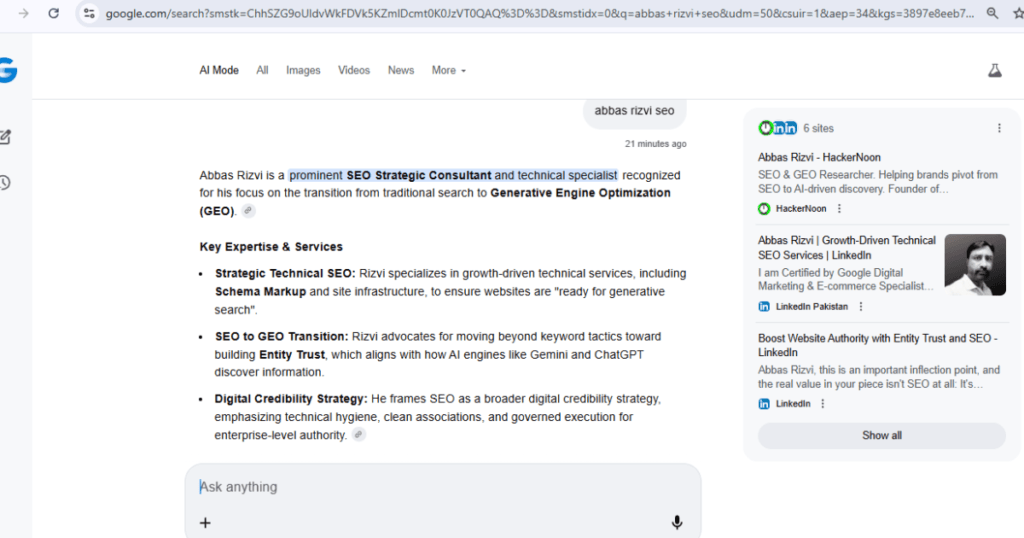
- Person Schema: This connects you, Abbas, to your work. It should include your sameAs links (LinkedIn, HackerNoon, Twitter). This tells Google: “The person who wrote this technical audit is the same expert mentioned on HackerNoon.”
- Organization Schema: This defines your brand as an entity. By nesting your Person schema inside your Organization schema, you create a “Connected Knowledge Graph.”
Pro-Tip: In 2026, don’t just use basic Article schema. Use knowsAbout properties to list the specific technical topics you are an expert in (e.g., “Technical SEO,” “Core Web Vitals,” “Generative Engine Optimization”).
Section Breakdown: The “Answer-First” Structure
AI models are programmed to find answers quickly. If you hide your main answer at the bottom of a 2,000-word post, the AI will find a shorter, clearer competitor instead.
- The “Featured Snippet” Block: At the beginning of every major section, include a 40-50 word summary that answers a specific “How” or “What” question.
- Bullet Points & Tables: These are the “fast tracks” for AI scrapers. Our checklist below is designed specifically to be pulled into a ChatGPT search result.
The GEO Roadmap: A 10-Step Checklist for 2026
Knowing the theory is one thing; executing it is another. To help you transition from traditional SEO to a dominant Generative Engine Optimization strategy, I have compiled this 10-step checklist. If you check these boxes, you aren’t just ranking—you’re becoming a permanent part of the AI’s knowledge base.
- Audit for “Consensus Content”: Review your top 10 pages. If they don’t offer a unique perspective not found in the top search results, rewrite them with original data.
- Optimize for “Natural Language” Queries: Stop targeting short keywords like “SEO tips.” Target full questions like “How do I optimize my WordPress site for Google SGE in 2026?”
- Implement JSON-LD Person Schema: Ensure your name is technically linked to your brand and your external publications (like HackerNoon).
- Maximize Factual Density: Remove filler words like “actually,” “very,” and “really.” Replace them with metrics and specific case study results.
- Achieve “Elite” PageSpeed: Aim for a 90+ Mobile score. AI agents prioritize fast-loading “clean” HTML for their real-time synthesis.
- Create “Cite-able” Visuals: Design original diagrams that explain complex concepts. Use descriptive ALT text so AI can “read” the image.
- Use High-Value Technical Anchor Text: When linking internally, use descriptive anchors that define the relationship between pages.
- Build “Off-Page” Entity Trust: Get mentioned on authoritative, niche-relevant platforms to prove to the Knowledge Graph that you are a real-world expert.
- Modularize Your Content: Break long sections into smaller, “atomic” blocks with clear H3 subheaders. This makes it easier for Gemini to “clip” your content.
- Monitor Your “Brand Mentions”: Use tools to track how often AI models cite your brand, even when they don’t provide a direct link.

Case Study: The “HackerNoon” Effect on Entity Trust
To understand the power of Generative Engine Optimization (GEO), we must examine how high-authority mentions shape the “Knowledge Graph.” Recently, I published a technical audit on HackerNoon titled “Optimization Log: How I Pushed a 2,750-Word Guide to 97/100 PageSpeed.”
Why this matters for my GEO Strategy:
- Cross-Entity Verification: When a high-authority tech site like HackerNoon links to TheAbbasRizvi.com, it creates a “Trust Bridge.” AI models see this and assign a higher “Authority Score” to my domain.
- Signal Integrity: The audit provided raw data on TTFB (Time to First Byte) and CLS (Cumulative Layout Shift). By providing this “Hard Data” to the web, I’ve given AI engines a “Primary Source” to cite when they synthesize answers about WordPress optimization.
- The Result: Since the publication, my brand name is now more closely associated with “Technical SEO” in vector space. This is the goal of GEO—making your brand synonymous with your expertise.
Frequently Asked Questions (FAQ)
Q1: How is GEO different from traditional SEO?
Ans: Traditional SEO focuses on keywords and backlinks to rank “Blue Links.” GEO focuses on Factual Density, Information Gain, and Schema to ensure your brand is cited as the source of truth within AI-generated answers.
Q2: Will GEO help me if my traffic is already dropping?
Ans: Yes. Traffic drops in 2026 are often caused by “Zero-Click” searches. By optimizing for GEO, you ensure that even if a user doesn’t click, your brand is credited in the AI snapshot, building long-term “Branded Search” value.
Q3: Does PageSpeed affect AI search results?
Ans: Absolutely. AI engines use “Real-Time Synthesis.” If your site is slow, their scrapers will timeout or prioritize a faster “Atomic Block” of content from a competitor. A 90+ PageSpeed score is now a prerequisite for AI referenceability.
Q4: What is “Information Gain” in SEO?
Ans: Information Gain is the unique value or data you provide that does not exist in other top-ranking articles. Google patents suggest that “Novelty” is a high-weight ranking factor in the age of AI-generated content.
Final Thoughts: Leading the Conversation, Not Following the Algorithm
The transition to Generative Engine Optimization is more than just a technical update; it’s a mindset shift. In the old world, we were at the mercy of the “Blue Link” algorithm. In the new world, we are the architects of the information that AI consumes.
By focusing on Information Gain, Entity Trust, and Technical Integrity, you stop being a victim of “Zero-Click” search and become the authority search engines rely on.
Remember, in 2026, leadership belongs to those who design systems to be referenced, not merely discovered. It’s time to stop chasing the algorithm and start leading the conversation.
Is your traffic dropping? Let’s discuss your GEO strategy.